Ship Handling and Stability in High Seas - Tumblehome Hull Model Test
(anticipated full release, early spring 2016)
This discussion on the US Navy, 14,564 DW (deadweight) ton, 600' ft (182.9 m) long, 80.7' ft (24.6 m) beam (width), Zumwalt class DDG 1000 Tumblehome Hull Destroyer (xxxx, 2013)[1] is primarily focused on the vessel's handling characteristics in high sea conditions of [7+], relative to the standard flam or flared (concave to normal) hull design, along with ship to ship interactions. For a list of sea state conditions and associated wave heights, see (Tab. 1) below.
For a point of reference, I have been attached to two, and aboard three, separate classes of US naval vessels in blue water, from 3,400 DW ton Fast Frigate and 37,000 DW ton Replenishment Oiler to 64,000 DW ton Aircraft Carrier from which, twice capitulated off the deck in S-3 Vikings. Received my helm and steering qualifications while serving on board the 3,400 ton warship, from both the bridge and after steering. In addition, have discharged in excess of 150 rounds of 5" munitions upon targets of various nature, the vessel being awarded the Battle E, along with servicing Fire Control (FC) systems from Mk56, Mk86, Sea Sparrow Mk99 to Phalanx CIWS, to the discharging of small arms such as the .50 cal M2 from the deck of a vessel while underway.
Having such ship handling skills and weapon systems experience, dismayed by the apparent poor sea handling, healing, broaching, pitching bow, and wash water characteristics seen in the video (Vid. 1) and captured still images (Figs. 3-8, 11-12) of the DDG 1000 tumblehome (normal to convex) hull, complied by Defense News, Chris Cavas (Fall, 2006).[2] The still photos and video being composed of laboratory tank and open water tests performed by the Naval Surface Warfare Center (NSWC), Carderock Division and Office of Naval Research (ONR), utilizing a variety of scaled models of the DDG 1000, tumblehome hull.
[3][4]
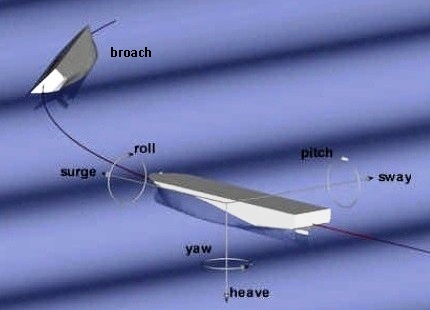
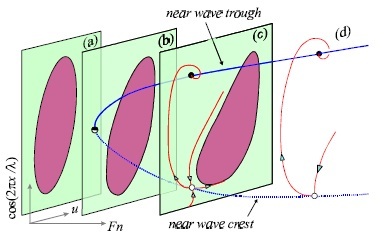
(Fig. 1, left) Illustration showing a ship hull's freedom of motion and respective labels, ending with a broaching event condition (upper left) as the vessel turns hard to starboard (right)(xxxx, xxxx).[5] (Vid. 1, 6.21 MB wmv, right) Compiled video of the USS Zumwalt scaled down tumblehome hull model performing maneuvering, and sea worthiness tests, reported by Defense News, Chris Cavas (2007).[6] In this video, the open water steady state sea conditions, scaled relative to the DDG 1000 model, never appearing to exceed sea state [6] or waves in excess of 19' feet (5.8 m) in height. Refer to (Tbl. 1) for sea state conditions and associated wave heights. The stern and fantail of the vessel appearing to heave and sway wildly at time [01':28" - 01':34"].
In addition to having reservations regarding the DDG 1000's general sea handling characteristics, would like to have seen more studies and or testing specifically orientated to address possible negative effects and new limits placed upon the full range of tumblehome vessel to vessel movement and intervention maneuvers, relative to other hull forms such the standard ONR "topside flared freeboard" or "topside flam freeboard" hull design series and nearly ubiquitous with current frigate and destroyer classes.
[x]
(Fig. 2) Comparison images of obtuse angle (> 90 degrees) "V shape" (upper) and normal angle (~90 degrees) "H shape" or wallsided (center) hulls in Flam, convex (left) and Flare, concave (right) configurations compared to the acute angle (< 90 degrees) "inverted V shape" (lower) Tumblehome hull.[x]
The omission of a flared bow on the DDG 1000, having been superseded with a centerline slopping (inward) tapered bow as appose to an outward slopping bow, per the Defense News (Cavas, 2007) video of the NSWC and ONR tank test of the DDG 1000 Tumblehome hull model, generating immediately noticeable and highly different wash water characteristics upon the vessel's forward hull section as the ship pitches downwards. The antithetical, non outward (forward) flaring bow, more specifically the segment of the vessel's bow that is above the waterline and known as the prow, for the DDG 1000, rather than displacing water away from the leading section of the hull as is the case with most vessels (Fig. 3), thus ejecting water out and away from the vessel's path, instead resulting in water being drawn rapidly up and towards the vessel's forward area.
[x]
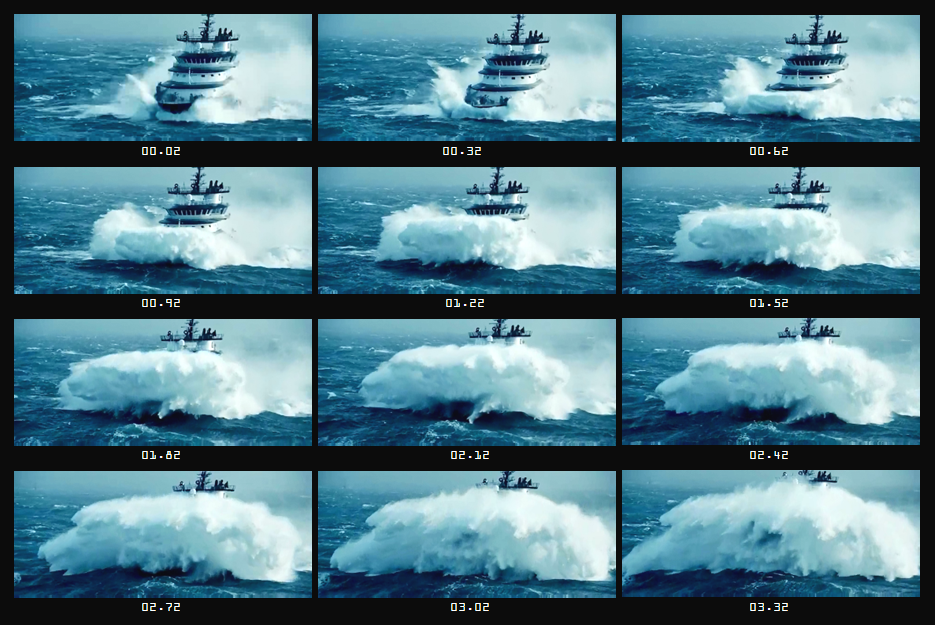
(Fig. 3) Collection of video still frames (3.3 second sequence) showing the water displacing and ejecting effect of a typical flare (concave) or flam (convex), obtuse angle, non tumblehome or acute angle hull design during rough seas. The water defecting away from the vessel, both to the sides and forward of the prow in a fan like pattern, where as the prow of the DDG 1000 USS Zumwalt accumulates water, shoveling displaced water up onto the vessels weather deck (xxxx, xxxx; adapted, McGraw, 2014).[x]
The shape of the DDG 1000 bow, as it submerges below the water, resulting in a momentary volume void (air pocket) equal in size to the non integrated flare bow section that would otherwise be situated below the water line. Such that, as the inward tapered bow of the USS Zumwalt dips below the water level, plied waters immediately advance up and onto the vessel's forward weatherdeck (Figs. 4, 5). The rushing waters ultimately vectored and ejected upwards as the port and starboard advancing waters columns collided above and near the vessel's bow centerline, this newly formed wave crest eventually to fall back upon the ship's weatherdeck.
Depending on sea state conditions and ship's speed, this potentially large mass of water landing near or upon the forward AGS gun mount housing, resulting in undesirable additional exposure to high pressure water. The higher velocity water flowing over the lifting body like shape of the gun mount housings, given certain conditions while the bow is submerged, possibly resulting in hydrodynamic effects very similar to aerodynamic effects acting upon a foiled wing, generating a secondary lifting effect upon the gun mount. In very violent sea states, given a large volumes of water flowing over the gun mount housing, as the bow submerges below the water, perhaps sufficient in scale and velocity to lift if not wash away (exfoliate) the forward AGS gun mount from the weatherdeck, flooding the compartments below.
The signature like wash water characteristic shown with the model of the DDG 1000 being unique to the current list of commissioned US Naval combatant or non combatant ships currently on the vessel registry.
[7][8]
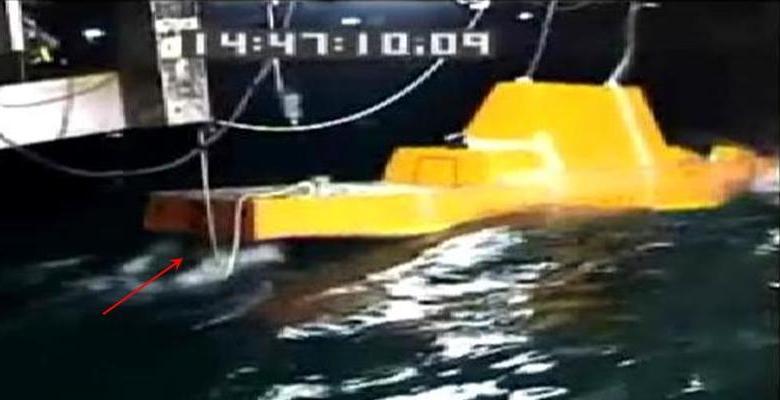
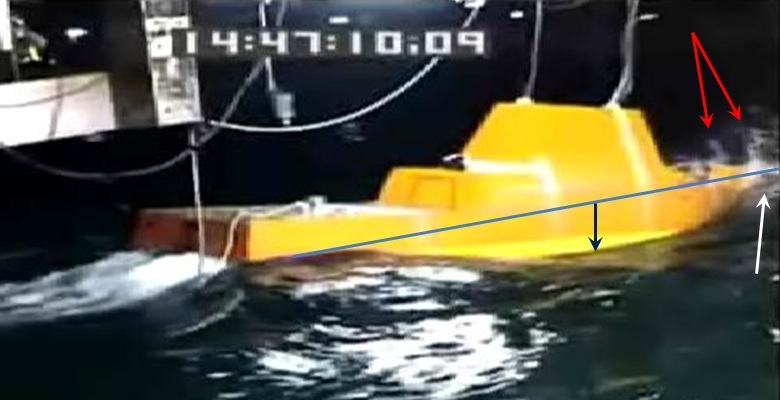
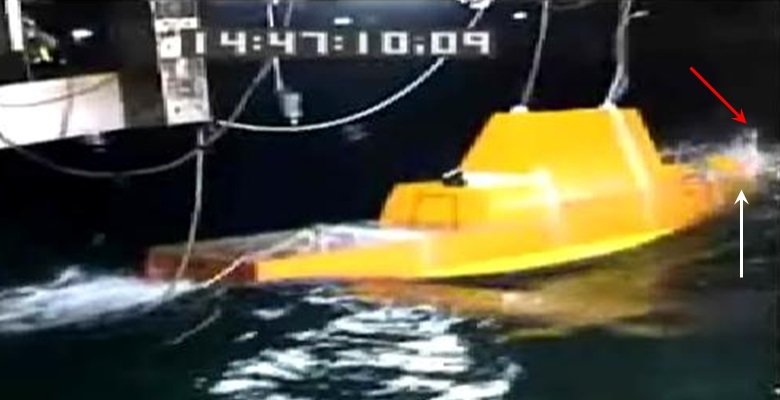
Laboratory tank test, still frame images of the USS Zumwalt, DDG 1000 Tumblehome hull sea worthiness and hull response characteristics (Defense News, Fall 2007)[9] during moderate to high sea state conditions. In the still frame at left (Fig. 4, left), the stern along with both screws at the bottom of the tumblehome hull have risen completely out of the water (red arrow) with the portside (left) rudder visible as a dark rectangular object. This type of situation, potentially leading to a non turn related broaching of the ship, as the vessel is no longer being steered by the rudder. The effectiveness of the propulsion system, with the twin screws out of water and the underside of the hull exposed, being seriously reduced.
The video still frame at right reveals the simulated sea state conditions (light blue line) used during the tank test (Fig. 5, right), relative to the scaled DDG 1000 model and minus wind effects upon the superstructure in this case the deckhouse. The largest single cress to trough height of the simulated waves measuring approximately 28' - 30'feet (~8.5 - 9.1 meters) or sea state [7] (dark blue arrow), the steady state waves being ~18' - 20' ft (~5.4 - 6.1 m) or sea state [6] using a vessel freeboard height at the hanger bay of 22 feet (~6.7 meters) for scale. The conditions stated in the ONR tank test report being sea state [8] or ~30' - 46' ft (~9 - 14 m)(Menard, 2010).[10] The entire foredeck and most of the leading AGS gun mount,[11] fully submerged below the advancing wave, as the ship's less buoyant non flaring bow pierces low into the cress of the advancing wave, as appose to riding higher. The water directly striking the planar face of the gun mount visible as two upward columns of water (two red arrows).
The above waterline segment, or inward tapered, inverted prow section of the bow of the USS Zumwalt, rather than displacing water away from the hull and vessel's path as it moves forward, instead causing just the opposite effect, with the encouraging of water to directly encroach upon the vessel's weather deck. This dangerous volume of water for personnel topside, being composed of plied waters directly in front of the ship's bow to water immediately aft, to the port and starboard (white arrow) of the inward sloping piercing bow and hull.
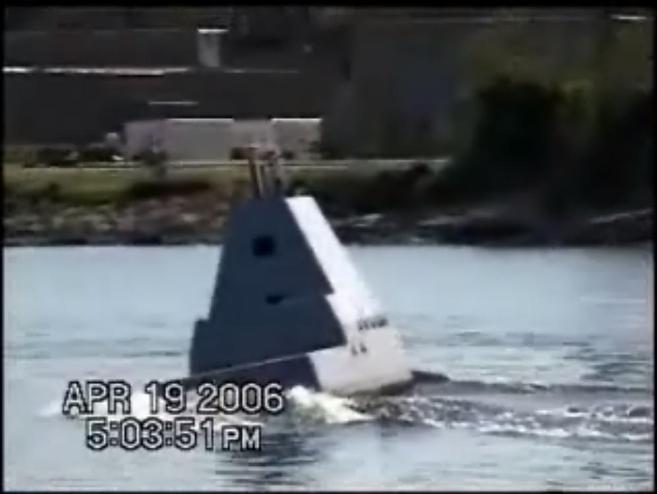
The Zumwalt class ship, with its use of a non flared, or flam hull design (Lewis, 1988; O'Rourke, 2009)[12], [13] along with low center of buoyancy, high center of gravity (KG)[14], and large superstructure wind load, requiring extra ballast mass, resulting in some precarious open water testing scenes from relative sea state conditions that from scale, do not appear to reach a steady state minimum sea condition of [6], (Figs. 4-9) and defiantly below sea state [8]. The complex roll stability issues inherent to the tumblehome hull (e.g. DDG 1000, USS Zumwalt) along with related catastrophic rollover (capsize) concerns during high sea conditions of sea state [8] having been computer modeled prior to scale model simulations (Vanden Berg, 2007; Bassler, Peters, Campbell, Belknap, and McCue, 2007). [15], [16]
[17][18]
(Fig. 6, left) In this video still frame with the simulated sea state conditions not exceeding [7], the forward gun mount on the DDG 1000's weather deck is nearly completely submerged (white arrow). The large curtain of water (red arrow) being pitched upwards measuring ~20' ft wide, 6' ft deep and 30' ft in height (~6.1 x 1.8 x 9.1 m). The estimated volume and mass of this water curtain being ~3,600' cubic foot (101.9 m3), the total mass estimated to be 50 percent air by volume, or ~12,465 gallons (50,970 liters) of water, which is ~112,370 pounds (~56 tons, or ~51,077 kg) of ejecta.
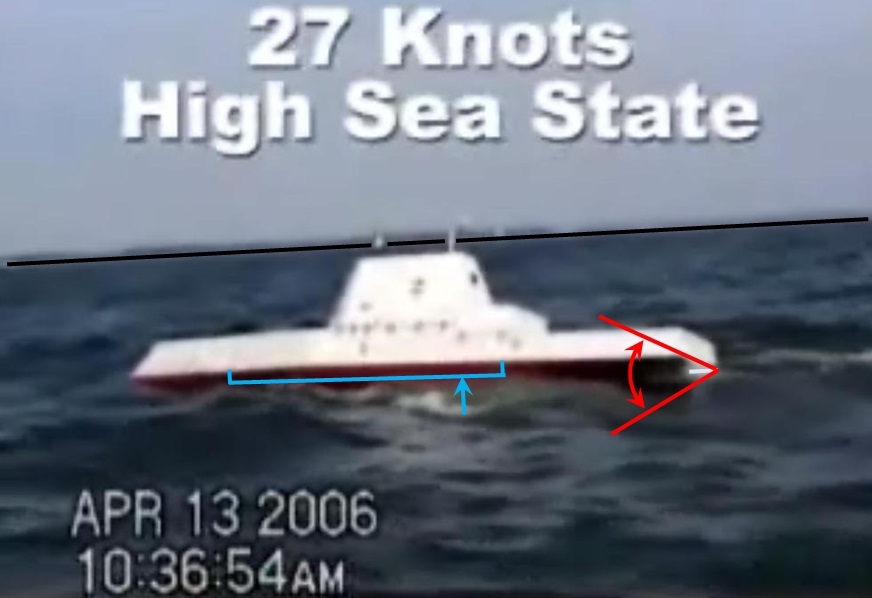
(Fig. 7, right) In this video still frame the scaled DDG 1000 model, during open water testing, experiences moderately high listing angles (red lines with arc), given an estimated steady sea state condition of [5 - 6] (blue arrow), measuring ~11' - 13' (~3.4 - 4 m). The scaled model the Zumwalt, from the non use of a faired of flam hull design with greater self righting properties in combination with the inherently high center of gravity (KG) and low center of buoyancy (KZ)[19] associated with the ONR tumblehome design, in addition to a long moment arm produced by the enormous and overbearing deckhouse, experiencing high heeling angles during rough to very rough [5 - 6][20] sea states and not that unusual a condition or yet an extreme environment for the oceans.
The range of claimed high sea state conditions exposed to the various scaled models of the tumblehome hulls tested by the NSWC and ONR, appearing consistently generous if not questionably overstated, rather than being conservatively rated, erring on the side of risk mitigation and crew safety. The performance focus of the DDG 1000 tumblehome hull design, from personal experiences, excessively design driven from the perspective of more streamline, laminar hydro dynamic performance in calm seas, reduced RF radar cross section (RCS)(Ellis, 1997)[21], thermal and acoustic signatures, all of which limited in value for a large surface object vulnerable to visual, hyper spectral sensors, and precision inertia/GPS guided munitions as appose to accommodating the full demands of blue water environments and naval assignments for this class of vessel.
[22][23] [24][25]
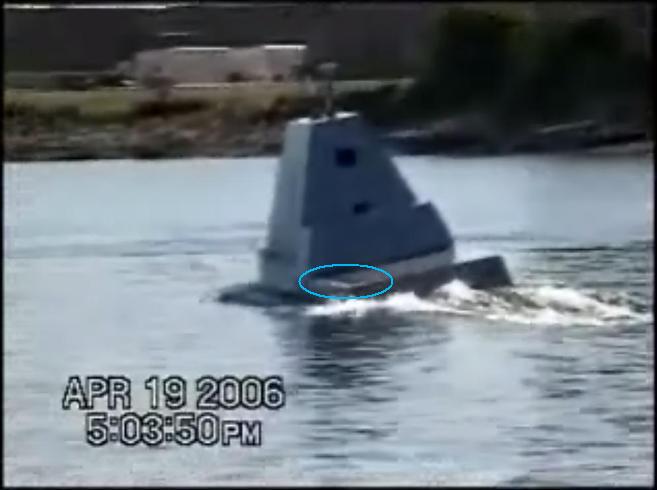
(Fig. 8, upper left) With the relative sea state approaching calm conditions, in addition to the apparent ease to which the tumblehome hull vessel heels while maneuvering, these hull dynamics magnified with the presence of high sea conditions, perhaps a direct effect produced by the non diverging (concave) or wallsided hull (Ellis, 1997),[26]. From the video, the freeboard angle of the tumblehome hull, demonstrating a tendency to displace large volumes of water to be washed onto the flight deck (blue oval) (Fig. 9, upper right). The fast moving sheeting water being a possible additional deck hazard during personnel movement and VERTREP (vertical replenishment) operations. The volume and depth of water, combined with a high sheeting velocity, being sufficient to knock a person off their feet, if not overboard. Myself, having been hosted multiple times to and from a moving ship, on to a hovering SH-53 or CH-46 helicopter overhead while underway, would not want to have the additional distraction of fast moving sheeting water upon the flight deck.
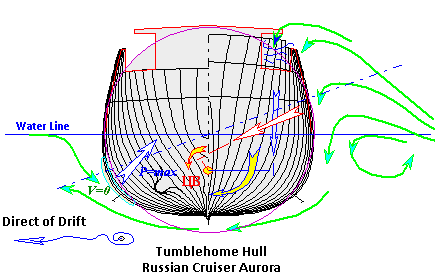
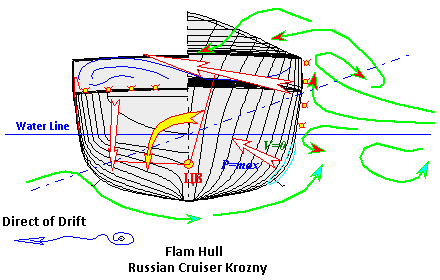
Examination of the hydro dynamic properties of a tumblehome hull (Fig. 10, lower left) using the cross section of the Russian cruiser Aurora (Khramushin, 2012; adapted, McGraw),[27] the freeboard angle converging towards the ship's centerline (acute), appearing to force (shovel) displaced water (green arrows) up the topside. The hull simultaneously rolling into the direction of the high water as the keel lists about the center of buoyancy, (φKZ), (yellow dot) into the direction of the waves being exerted upon the hull. The tumblehome hull not without some handling advantages such as experiencing less yaw in high seas as the waves impact the topside freeboard of the vessel with less force, resulting in reduced acoustic signature. The flared freeboard angle on a hull such as that found on an Arleigh Burke class destroyer and the similar flam hull modeled Russian cruiser Krozny (Fig. 11, lower right)(Khramushin, 2012; adapted, McGraw),[28] the topside angle diverging outwards (obtuse), away from the hull's centerline, resulting in the hull of the Arleigh Burke class ship to move over the surface of the water. The hull simultaneously rotating about the center of buoyancy (yellow dot) though unlike the tumblehome hull, the flam hull rolling away from the direction of the waves being exerted upon the hull.
The waters in the Central Pacific Ocean in the winter easily reaching in excess of sea state [8], and on one occasion from Hawaii to Guam, estimating conditions to have been equivalent to sea state [9]. The top of the large AN/SPS 40 air search radar on our ~415' (126.5 m) vessel, with the hull situated in a trough, well below the crest of the tallest waves. In these situations, if otherwise mild weather conditions, with safety gear donned, still permitted outside on to the weather deck to service the weapons fire control radar on the O-4.5 level.
[29][30] [31]
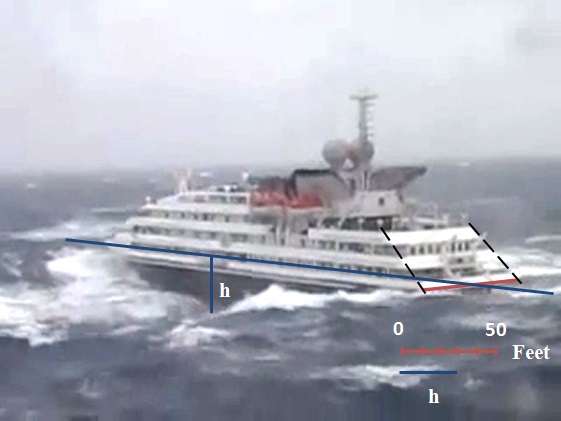
(Vid. 2, 5.61 MB mp4, upper left) Video of the 2,420 DW ton, 88 m (~289' ft.) long MV Clelia II in the South Pacific Ocean near Antarctica, December 2010, transiting Drake Passage (Cape Horn).[32] The cruise vessel Clelia II, as seen from the 732 DW ton, 292' ft (~89 m) long, MS National Geographic Endeavour (xxxx, 2010),[33] in 30 foot seas and experiencing an average sea state condition of [7], occasionally pitching at the bow 45' - 60' ft (13.7 - 18.3 m) in elevation. The surface wind conditions in the video, being relatively mild with the passing of an albatross like maritime bird in what appears to be controlled flight travelling pasting the camera lens field of view (FOV) at time 00:19" - 00:20".
(Fig. 12, upper right) Video still frame representing how the sea state condition for the Clelia II was determined. The reference dimension used being the vessel's beam width of 50'02". The crest to trough height of the largest visible wave straddled by the ship's hull while pitch neutral with the artificial horizon, and washing over the vessel's bow and weather deck, measuring ~30' (~9.1 m) (xxx, 2010; adapted, McGraw, 2013).[34]
(Fig. 13, lower) Photo of the MS National Geographic Endeavour (seen here as the former Caledonian Star) (Shebs, 2001)[xx] With its higher center of buoyancy and lower center of gravity from the combining of flam and flared hull form cross sections, in addition to being less rectilinear in overall shape, more akin to that of a 3,200 ton, 378' ft (115 m) long, High Endurance Hamilton Class Coast Guard Cutter, proving to be a more stable platform given high sea conditions.
Having been a member of the DES (Directed Energy System) team, reviewed some of the final CAD drawings for the entire vessel, and readily apparent to many, is that not all of the combat support systems can be entirely serviced from within the deckhouse. Some of the RF systems on the DDG 1000 class vessel requiring exterior topside work, and from such locations long moment arm distances from the ship's center of buoyancy. As such, resulting in personnel experiencing high angular velocities along with rapid transitions in direction as the ship list and heals from port to starboard while underway. Damage control (DC) repair efforts, be it from environmental factors or engagement, being equally hampered, resulting in extra vulnerable actions for the crew.
The presence of mild sea states conditions of 4 - 5, such as those experienced while transiting the Indian Ocean several hundred miles southeast of Sri Lanka (Ceylon), and not that unusual for the open oceans, even for a 3,400 ton vessel, challenging the crew's ability to perform critical maintenance and repair functions. In one situation, while repairing the IFF (Identification Friend or Foe) receiver for the weapons fire control radar, being rocked into an exposed 480V terminal mount, the 480V going in my right elbow and out the tip of the 4th finger, knocking me off the stool on to the deck. My right forearm and hand, for the next 7 - 8 days feeling like I just hit my "funny bone".
[35][36]
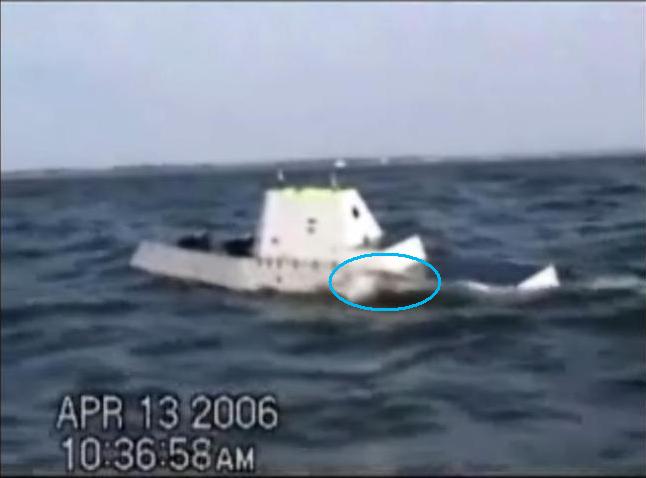
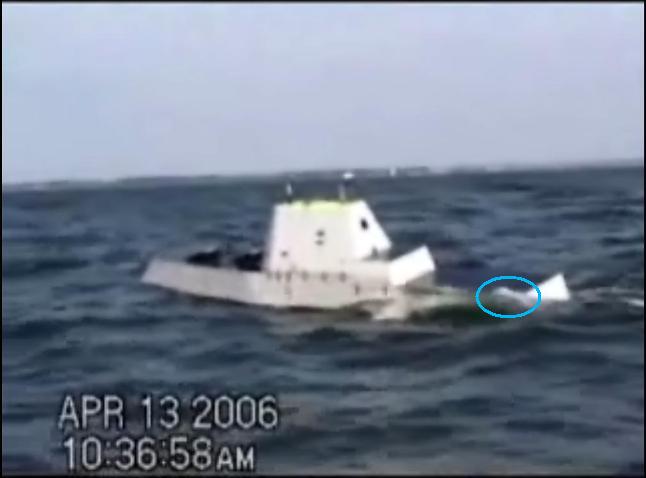
(Figs. 14, 15) Freeboard (12a) angle effect upon the helicopter pad and hanger bay during open water testing of DDG 1000 Tumblehome Hull during moderate (quartering) sea states (Defense News, Fall 2007).
In the video frame at left (Fig. 14, left), the forward port area of the Zumwalt flight deck, along with portions of the helicopter hanger bay door are subjected to a large body of water. The water rolling off of the hull of the vessel instead of being ejected away from the hull as is typical with a wallsided hull, or flared hull. This body of water having travelled up along the port side of the hull, just below the deckhouse. The water transitioning into a breaking wave (blue oval) with a very large face, weight, and velocity.
The frame at right (Fig. 15, right), ...
The most violent, high sea and typhoon conditions I've experienced and with little doubt in my mind certainly not the worst the oceans have to offer, occurring while transiting the East-South China Sea in route to the Philippines from Korea as part of the USS Kitty Hawk CV 63 carrier task force, ultimately in route under direct orders to the Seventh Fleet by President Reagan for Gonzo Station (Arabian Sea). So strong was the typhoon in the East-South China Sea area, the vessel making 18 - 20 knots, resulting in 42o - 43o degree port to starboard rolls from centerline, per the bubble inclinometer on the bridge. The ship pitching no less than 17o - 20o degrees bow to stern. The rolling seas, crest to trough being in excess of 50' - 60' feet (15.2 - 18.3 m) with a few waves being perhaps 70' - 80' feet (21.3 - 24.4 m) in height, estimating the sea state condition for that very unnerving 5 - 6 hrs to be a constant [8] and for brief periods [9] or greater. The harrowing transit through the China Seas being the only time while I was a member of the crew that all personnel were restricted, regardless of don foul weather gear, from being exterior the vessel while underway.
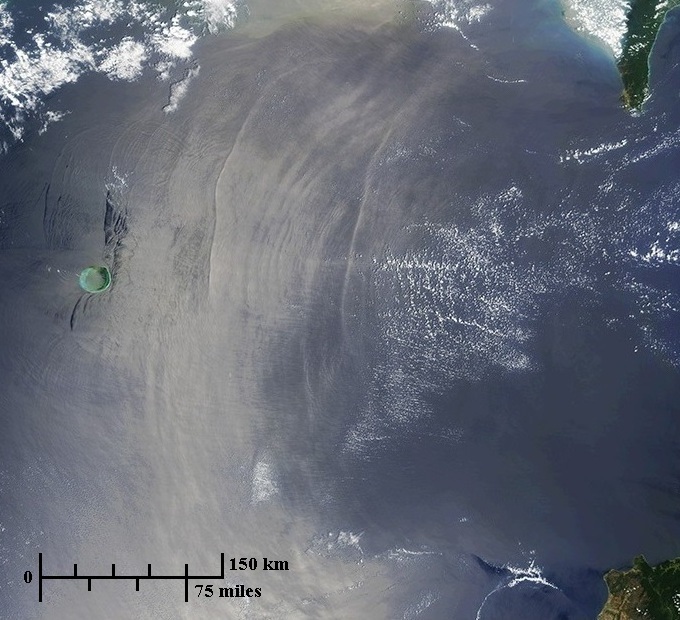
Recent oceanographic studies of surface and subsurface (internal) ocean wave formations in the area of the South China Sea known generally as the Luzon Strait (Lien, and Henyey, 2010; Mercier, 2013; Peacock, 2013), this expansive area bounded by the island of Taiwan, to the north east and island of Luzon, Philippines to the south east, covering approximately 55,000 square miles (~142,450 sq km) and performed by the University of Washington, ONR, Woods Hole Oceanographic Institution, Ecole Centrale de Lyon, University of Grenoble Alpes and Massachusetts Institute of Technology (MIT) in conjunction with satellite imagery of the region collected from the NASA MODIS Satellite (Fig. 16), have concluded this body of water to contain some of the largest waves of all Earth's oceans.[37], [38], [39] The wave energy levels being so great in scale, resulting in morphological formations on the surface of the ocean so large in magnitude and amplitude, that their individual wave structure shape in addition to the direction of propagating motion being visible from low earth orbit (LEO) (NASA, and Global Ocean Associates 2013).[40]
[41][42]
(Fig. 16, left) NASA MODIS satellite photo of the Luzon Strait region of the South China Sea. The central region in the photo, spanning from the large circular atoll know as Pratas Island (Dongsha) near left center to Taiwan at upper right with Luzon Philippines at lower right, covering approximately 250 x 220 miles (400 x 350 km) or 55,000 miles2 (~142,450 km2) of ocean area (NASA, and Global Ocean Associates 2013; adapted, McGraw, 2014). The large continuous wave crest formations ranging in excess of 200 km (155 miles) in length, the individual wave crests separated from one another by several to 10's of km.[43] The scale at lower left representing 150 km and 75 miles. (Vid. 3, right) Recreation animation of subsurface (inner) ocean waves generated by the presence of ocean ridges and sea mounts along the bottom of the Luzon Strait. The amplitude of these waves being upwards of 550' ft (170 m) in height (Mercier, 2013; Peacock, 2013).[44]
The internal, subsurface waves formations estimated from various studies and clearly animated in video (Vid. 3) by the team at MIT (2013), to be in excess of 550' feet (170 m) in height (Mercier, 2013; Peacock, 2013).[45] The production of subsurface turbulent structures in the ocean water being a direct result of shallow sea mounts and ocean ridges in the central region of the Luzon Strait (xxxx, xxxx).[46] In a simple analogous manner, these large magnitude wave formations and non laminar movements, being turbulent and concentrated much like the formation of orographic cloud formations visible in the atmosphere as a result of protruding surface formations (e.g. mountains)(xxxx, xxxx).[47] These very large internal ocean waves, though possessing different wavelength, frequently superpositioning in energy with the morphology of the over burdening surface waves, resulting in extraordinary surface wave heights and energy levels (Lien, and Henyey, 2010; Mercier, 2013; Peacock, 2013).[48], [49]
The exasperated wave heights typical to the Luzon Strait region of the South China Sea, needing to be competently mastered by all US Navy combatant surface and subsurface vessels, independent of naval architectural design philosophy selected. Every blue water rated US military vessels, for the sake of being capable of wielding functional command, thus not faltering from of its own design induced accord, for all weather, all sea state conditions naturally presence in maritime regions. In so doing, the US Navy retaining forward projection capacity while maintaining open all critical sea lanes and customary free passage ways in international waters. In conjunction with such task, retain ship handling capabilities that remain well within the understood parameters of safe and prudent vessel handing characteristics and response traits while transiting naturally turbulent waters.
[50][51]
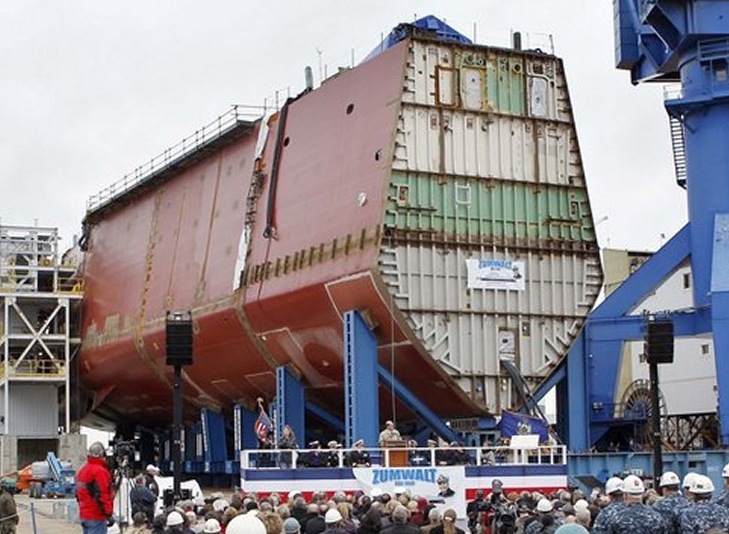
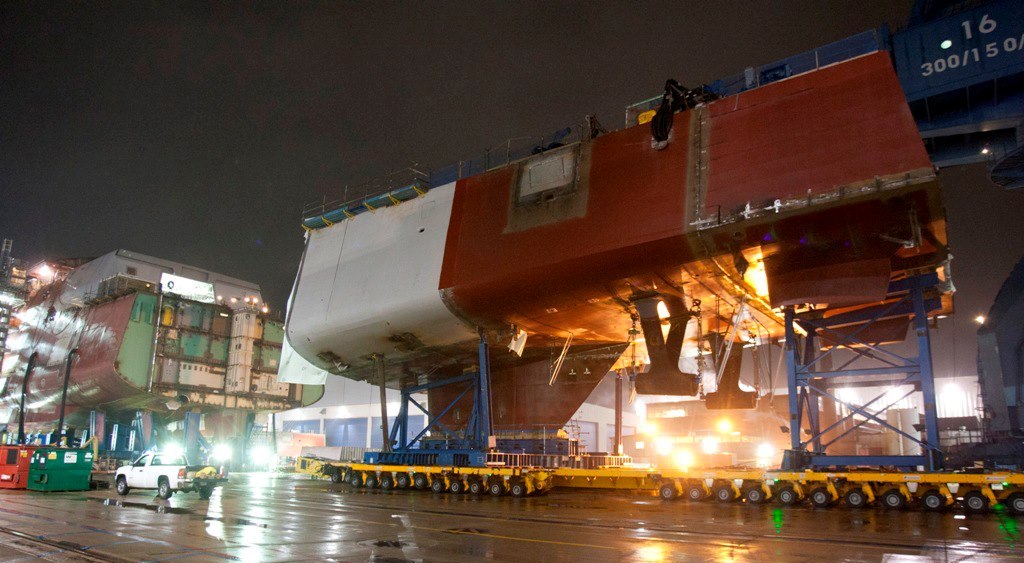
(Fig. 17, left) Photo of the still segmented and exposed cross section DDG 1000 tumblehome, forward hull segment to be fitted ahead of amidships, just aft of the bow (xxxx, 2012).[52] The deadrise angle of the hull's bottom, for this section of the vessel, as measured from the longitudinal centerline of the vessel (keel) to the start of bilge turn mating with the freeboard (sides), being very step. The width of the hull near the gunwale (top lip) being more narrow than the vessel's width at the waterline (beam), a signature characteristic of the tumblehome hull design. (Fig. 18, right) Photo of the still segmented, cross section revealing stern and fantail section of the DDG 1000 tumblehome hull while in transport at the Bath Maine Iron Works (xxxx, 2012),[53] to be mated with the rear midsection of the hull visible at left. The deadrise angle of the hull's bottom for the stern segment of the ship being nearly 0o degrees, and essentially a flat bottom with slight incline wedge to the fantail. Using such hull design, the center of buoyancy for the DDG 1000 translating along the vertical center plane a large amount and suddenly from near amidships to the stern segment, the bottom of the vessel transitioning prior to the aft superstructure frame, perhaps aggravating the vessels tendency to lift the stern out of the water in high sea state conditions as seen in the video still frame (Fig. 4).
From the violent hull vibrations produced by the bulbous sonar dome, while transiting the Luzon Strait, in addition to the rapid pitching, heaving and rolling of the ship's hull, making it nearly impossible to walk, supporting oneself with both arms reached out, pressing against the passage way. During this transit, nearly killed by a large steel desk in the Weapons Divison office that broke free from its deck securing bolts, while filling out the ASROC security log, violently slamming myself and the desk up against the bulkheads. The ship's mess deck closed for the day being too rough to prepare any meals including sandwiches, serving only crackers, crew not on watch remaining in their racks, conditions being too dangerous for general quarters. Violent sea state conditions, such as those that I experienced in the East-South China Seas, perhaps overwhelming a Zumwalt class DDG 1000 tumblehome vessel, resulting in the catastrophic loss of the ship and crew.
[54]
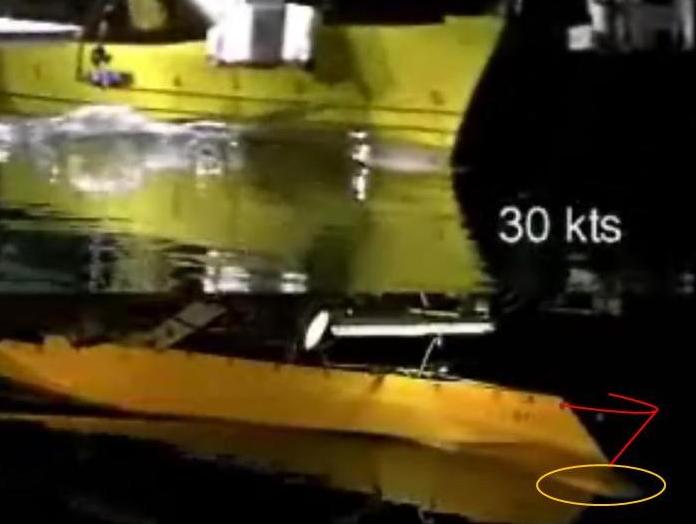
(Fig. 19) All thought the Defense News video (2007) makes note to the claim by the US Navy that the tumblehome hull, with the inverted tapered bow pointing aft, enables the DDG 1000 hull to be more streamline relative to the standard flam or flare hull bow design (bright yellow), wish to noted that the hydrodynamic resistance and drag coefficients experienced by the conventional hull used for the test is slightly disadvantaged relative to the tumblehome model. The conventional hull being void of a sonar dome or wave break equivalent, such structure permitting a vessel to experience reduced forward resistance(xxxx, xxxx).[56] Where as the tumblehome model (dark yellow) selected for the performance test is fitted with a structural equivalent to a sonar dome (yellow circle) and perhaps providing a slight edge to the tumblehome. A more realistic, parity based comparison of laminar flow performance between the two hull types being conducted with a tumblehome model void of a bulbous sub waterline prolated like leading structure.
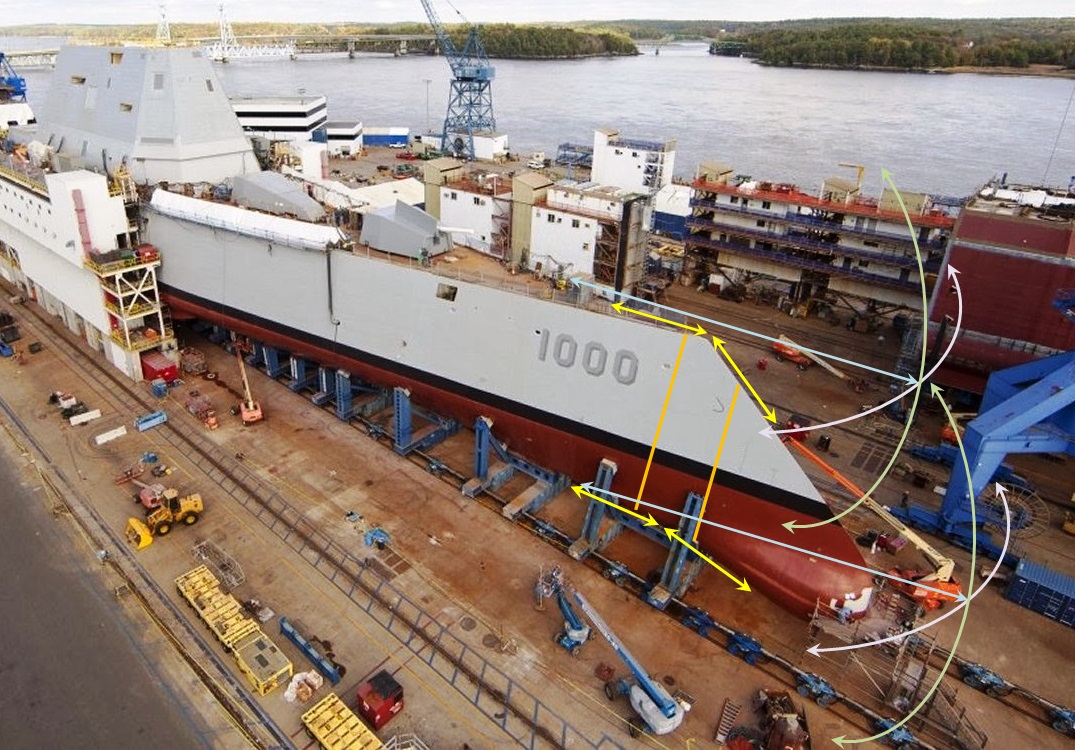
The section of the DDG 1000 Tumblehome bow that is topside the water line and inverted prow (red lines), leading to the vessel's distinctive forward shape, is noticeably void of a forward inclining flaring "hurricane" bow structure, and clearly visible on the prow section of the comparative standard hull model. This typical, flaring feature providing added structural reinforcement to the hull's horizontal centerline plane and buoyancy for the pitching bow during high sea state conditions (xxxx, xxxx).[57] With the mechanical structure enhancing topside prow feature being dismissed from the DDG 1000 hull design, should at the very least, experience higher levels of structural stress upon the pointed taper (Fig. 20). The sum of the stresses being a combination of tension, compression and shearing in the areas of the hull demarked with a pair of vertical (orange) lines, the dynamic forces being distributed into a smaller surface area and volume, with higher energy density.
Lateral forces placed upon a ship's forward section during very high sea conditions can result in the removal of the entire bow section as was the situation with the 14,500 ton, 673' ft long, Baltimore class heavy cruiser[xx] USS Pittsburgh, CA72, US Navy Third Fleet (Fig. 21). The ship on 5 June 1945, having the most forward 100'+ ft portion of the hull striped off during typhoon conditions in the China Seas with recorded wind speeds of 138 mile/hr[xx] and equivalent to a category IV hurricane.[xx]
[55][xx]
(Fig. 20, left) The large external forces being the product of the tremendous oscillating horizontal (lateral) forces (light purple arrows) relative to the ship's pitching motion (vertical) and associated forces (light green arrows) generated by the bow fitted sonar dome (wave break) as this heavy ship's accelerating bow is forcibly driven below the water surface at a submerged depth and velocity, greater than that experience by a vessel with standard flared hurricane bow. The orthogonal lateral forces placed upon the hull being similar to those experienced by a person playing in a swimming pool, attempting to force their open hand down into the water, the hand mimicking a sonar dome, oscillating left to right as it moves vertically in the water. A ship's sonar dome, and or wave break behaving in the same manner. These oscillating forces upon the hull, being noticeably visible in (Vid. 5) of the F-70 class French Fregate Latouche Treville below. [xx]
(Fig. 21, right) Aerial photo of the USS Pittsburgh CA72 (circa June 1945) with missing bow section while enroute to Guam for repairs (Naval History and Heritage Command, photo 80-G-325746).[xx]
[xx]
(Vid. 4, 48 MB wmv) Universal Newsreel of the US Navy heavy cruiser USS Pittsburgh CA72 with the forward 100'+ ft section of the vessel's bow "the suburb of Pittsburgh" (US Steel Factory, McKeesport PA) ripped off by a typhoon with wind speeds of 138 mile/hr[xx] (category IV hurricane).[xx] At the time, the USS Pittsburgh was part of Admiral Halsey's, Third Fleet, Carrier Task Force (Albert Grobel, July 1945, Universal; adapted, McGraw, 2016). A total of 21 ships being damaged in the typhoon. Fortunately, no personnel were lost on the USS Pittsburgh during the structural failure event. [xx]
The DDG 1000, tumblehome hull being void of a fairing bow (hurricane bow) submerging to a greater depth, and visible from the Defense News video of the ONR tank test, the tumblehome hull generating less displaced water as a function of increasing draft depth of the forward bow. The tumblehome hull when submerged, though possessing less mass than a typical scale to proportion flared bow, and small fraction of the entire vessel's mass, possessing less buoyant force as the bow submerges. The reduced buoyant force present in the bow, should in theory, result in the tumblehome hull being prone to deeper and longer duration submerge cycles. Indications of precisely this type of hull pitching response to high seas becoming apparent from the NSWC/ONR tank test. (Vid. 1)
[58] [59] [60]
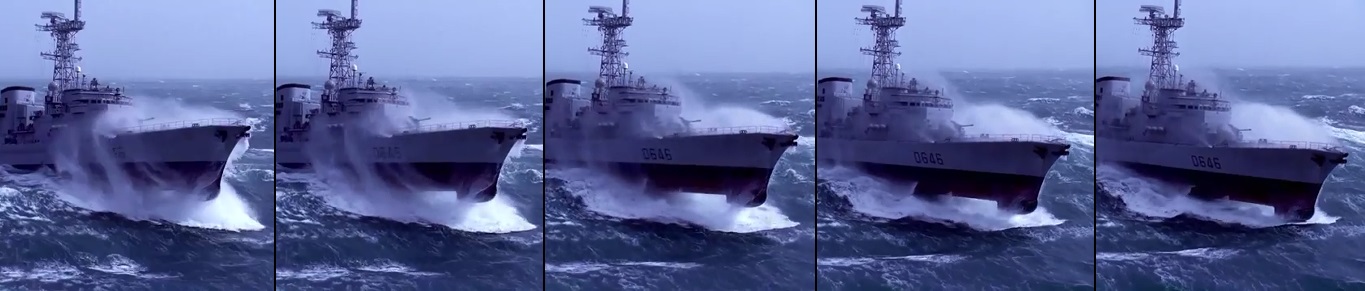
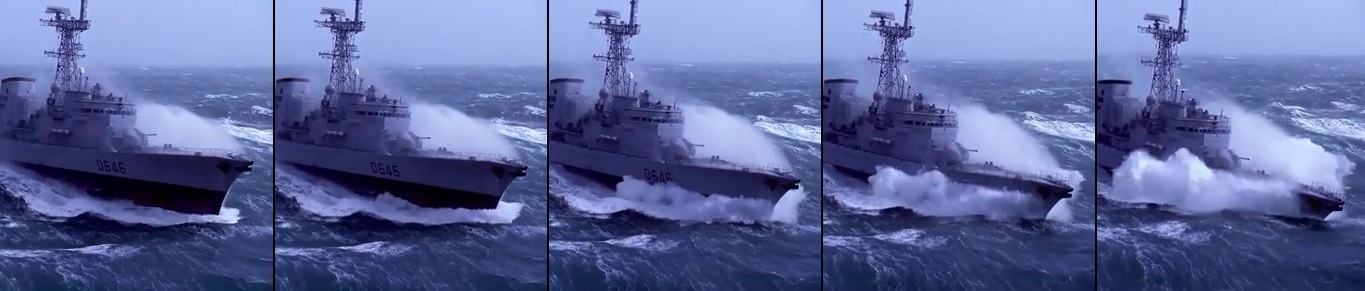
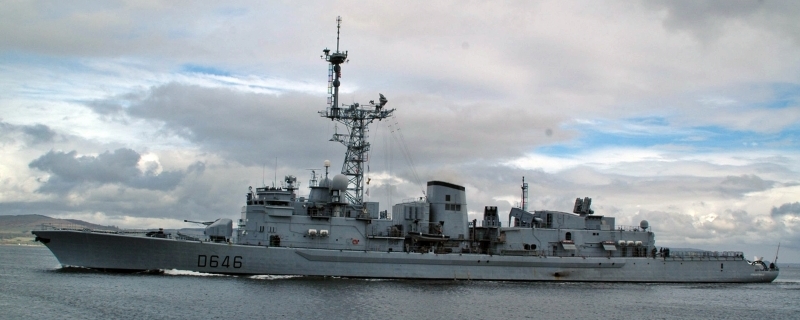
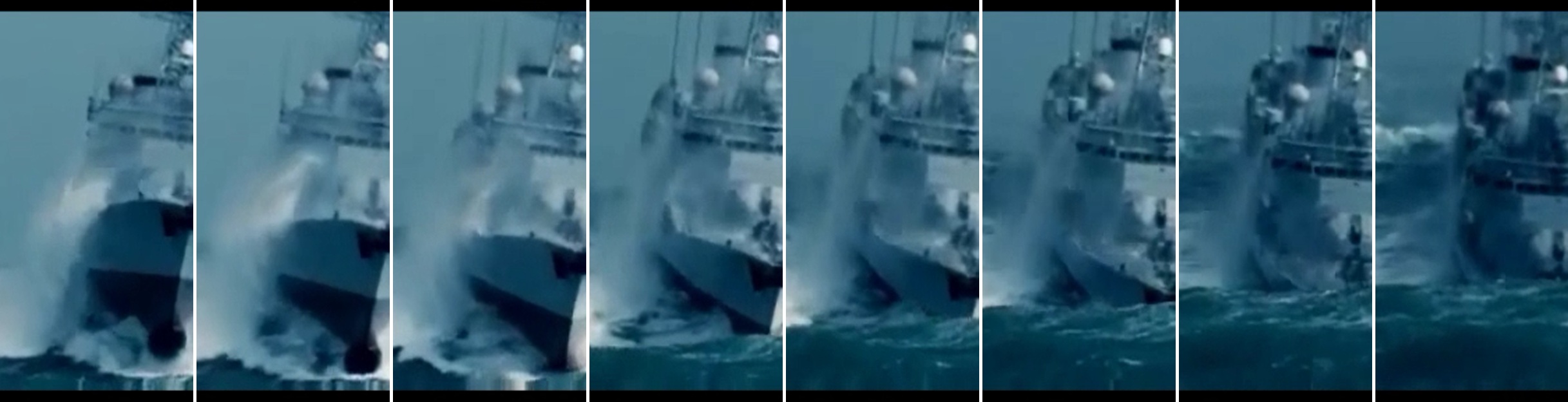
(Fig. 22, upper) Video still frame sequence of porpoising like breaching of the waves and associated bow pitching (rising and submerging) of the 139 m (456' ft) French Fregate, Latouche-Tréville D 646.[62] The sequence of still frame video images showing the pitching and cantilevering of the flare hull Latouche-Tréville's forward section (Marine Nationale, 2012; adapted, McGraw, 2013).[63] The vessel surging forward as the surface area of the hull in contact with the water decreases, reducing the net surface friction imposed upon the ship's hull. This viscosity interaction function of the water with the hull of the vessel being explained with Michel's integral for wave resistance coefficient, the resistance coefficient (Rx) or (Cr) being proportional to the vessel's wet area Aw(ϑ) as a function of wavelength (λ), phase angle (k) and wave incident angle (θ) with the hull (Taylor, 1979; Lewis, 1988; Bassler, 2007; Khramushin, 2012).[64], [65], [66], [67] The moment arm of the bow's thrusting and compressing force as the sonar dome makes contact with the water, being determined from the forward location of the first supporting wave. This cantilevering distance being close to 150' ft (46 m), extending to the vessel's aft bridge wing frame. (Fig. 23, upper center) Still frame video images showing the submerging of the Latouche-Tréville's bow and hull, from the moment the ship's keel makes first contact with the surface of the water (Marine Nationale, 2012; adapted, McGraw, 2013).[68] The vessel's topside section of the flared bow or prow, displacing a non linear and increasing rate of water volume as a function of submerged depth. The forward section of the flared prow, in particular the portion forward of the hull's waterline, in addition to retarding the depth to which the bow nose dives into the water, simultaneously increasing the amount of buoyant force as the volume of displaced water is replaced by the bow. (Fig. 24, lower center) Video still frames of the entire bow, to include the foredeck, of the Latouche-Tréville below the surface of the water. The vessel being fashion with a flaring prow, reducing the vertical velocity of the bow as it enters the water in addition to providing increased buoyancy, thus inhibiting the pitching vessel from submerging excessively. The ~1 m (~3' ft) tall lifeline railing directly above the bow's most forward point and bull nose, beginning to surface in the last frame at right (Marine Nationale, 2012; adapted, McGraw, 2013).[69] (Fig. 25, below) Profile photo of the French Marine Nationale, F-70, Georges Leygues class, anti-submarine Fregate, Latouche-Tréville D 646, seen here at Greenock, UK in preparation for Operation Joint Warrior (Ship Spotting, 2012).[70]
[61]
Unlike other surface warfare vessels in the US Navy (see Fig. 33), the stern section of the DDG 1000 tumblehome hull, beginning its trailing keel taper towards the fan tail from just past amidships, resulting in a large reduced draft. The majority of this draft reduction complete by the end of the keel fin (see Fig. 18).
The shallow draft cross section of the DDG 1000 hull from just past the deckhouse, reducing the net vacuum restoring force for the stern as the ship plies over the leading edge of a large wave crest, followed in kind with the bow pitching downwards in an accelerating manner. The lost of this countering force, and partially responsible for regulating the amount of cantilevering experienced by the hull in addition to where along a wave crest the ship's pitch becomes negative.
[71] [72]
(Figs. 26, 27) Yaw motion of French Fregate (officially destroyer class) Latouche-Tréville D 646 in sea state [7] conditions. This traditional hull type displaying yaw induced lateral forces produced by the ship's sonar dome.[73]
The sequence of still frame video images at top (Fig. 26, upper) shows yaw motion in the hull of the F-70, Georges Leygues class, 4920 DW ton, 139 m (456' ft) French Fregate (officially destroyer class) Latouche-Tréville D 646 (Marine Nationale, 2012; adapted, McGraw, 2013), (translations and or rotation about azimuthal plane from bow to stern) [25] as a result of lateral forces upon the forward bow section generated by the ship's sonar dome. This force being the direct result of the pitching hull, moving the ship's bow and sonar dome rapidly about the vertical plane as they plunge in and out of the water. The lateral forces and total horizontal translation distance traveled by the bow hence total extent of yaw, damping with depth. The lateral resistive forces produced by the submerging flared hurricane bow, and bilaterally symmetric and coincident along the vessels vertical longitudinal center plane, providing some listing and yawing stabilization to the forward section of the vessel, with the maximum prow flare expanding just past the vessel's bull nose and longest effective moment arm. The estimated steady state, sea condition being [7] with periods of sea state [8], the maximum measurable wave being ~36' feet (11 m) crest to trough. The second sequence of still frame video images beneath (Fig. 27, lower) showing the same vessel ... The video (Vid. 5, 11.5 MB, mp4) from which the still frames were collected (Marine Nationale, 2012) can be seen below.[74]
In theory, such ship handling characteristic, resulting in the DDG 1000, and concurrent with what can be viewed from the ONR tank test (see Vid. 1) with the vessel exposing her screws, resulting in the ship's bow to submerge deeper below the surface of the water in high sea conditions, the hull rotating sooner, the vessel's bow placed closer to the center of the wave trough.
[75]
Sea States and Heights, m (ft)(xxxx, xxxx)[76]
0
0
1
0.0 - 0.1 ( 0.0' - 0.3' )
2
0.1 - 0.5 ( 0.3' - 1.6' )
3
0.5 - 1.25 ( 1.6' - 4.1' )
4
1.25 - 2.5 ( 4.1' - 8.2' )
5
2.5 - 4.0 ( 8.2' - 13.1 ')
6
4 - 6 ( 13.1' - 19.7' )
7
6 - 9 ( 19.7' - 29.5' )
8
9 - 14 ( 29.5' - 45.9' )
9
14 - 20* ( 45.9' - 65.6' )
10*
20 - 28 ( 65.6' - 91.9' )
11*
> 28 ( > 91.9' )
(*) Proposed Sea State Scale Modifications
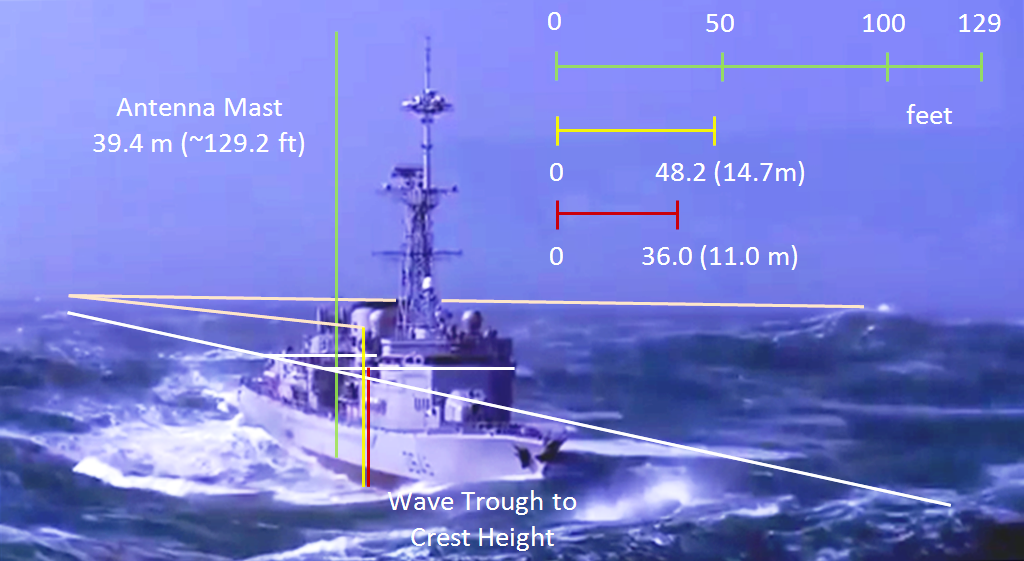
(Fig. 28, left) Contrast enhanced still frame video image demonstrating how the sea wave height, thus sea state range of [7 - 8] was determined for the underway scenes of the Latouche-Tréville D646 (Marine Nationale, 2012; adapted, McGraw, 2013).[77] The reference object used to vertically scale the area of interest being the ship's 39.4 m (~129.2' ft) antenna mast (green line) (xxxx, 2012),[78] as measured from the vessel's waterline. The largest wave measurable from the video in which the ship is placed in, being ~36.0' ft (~11.0 m) in height (red line), with the largest wave crest in the same video frame though not valid for determining sea state conditions, not having a visible local trough for reference, measuring ~48.2' ft (~14.7 m) (yellow line) relative to the vessel's local trough, with an estimated error of +/- 10" inches (25 cm). (Tbl. 1, right) Table of sea state conditions (left column) compared to their respective wave heights (right column). This author proposing that the current sea state condition range is increased by two sea state levels. Extending the top end, height defined wave profile range from [0 - 8] with sea state [9] being a non top end undefined >14 m to a defined wave profile range of sea states [0 - 10] with sea state [11] accommodating non height limit defined waves in excess of 28 m (>92' ft).
[79]
(Vid. 5, 13.8 MB mp4) Video of the F-70 Georges Leygues class French Fregate Latouche-Tréville D646 while underway in the North Atlantic Ocean (Marine Nationale, 2012),[80] the estimated sea state condition being [7-8]. This excellent video production clearly presenting during times [01':06" - 01':12"], [01':18" - 01':20"], and [02':12" - 02':14"] the pronounced vibrating effects upon the ship's flared hull and bow design as the fully breached and exposed sonar dome, located at the most forward section of the hull, the vessel still accelerating due to reduced surface area induced hull friction with the water, penetrates the waves, rapidly decelerating. The measured moment arm for this water reentry force being ~150' (~45.7 m) as the ship pitches forward in a porpoising like manner. The submerged portion of the hull's stern, as the bow of the vessel drops in elevation, resulting in a slight vacuum induced restoring force, thus preventing the ship's bow from experience the full kinetic energy associated with the rotating moment arm of the hull's forward section.
[81][82] [83][84]
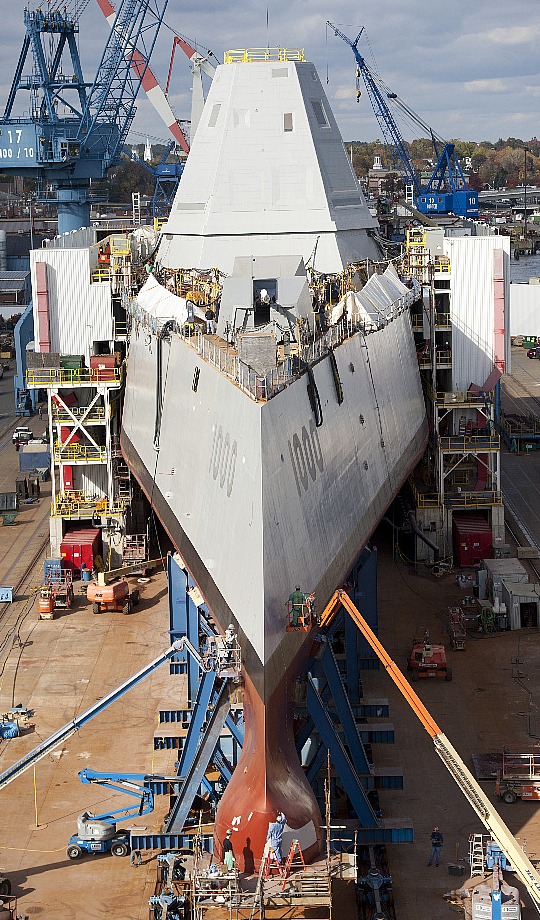
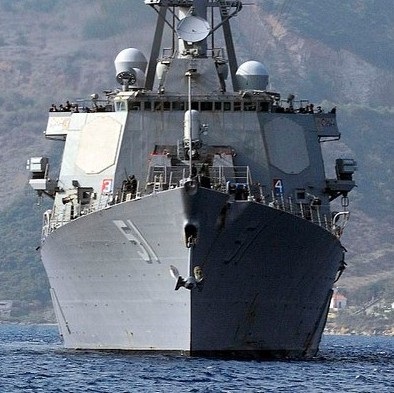
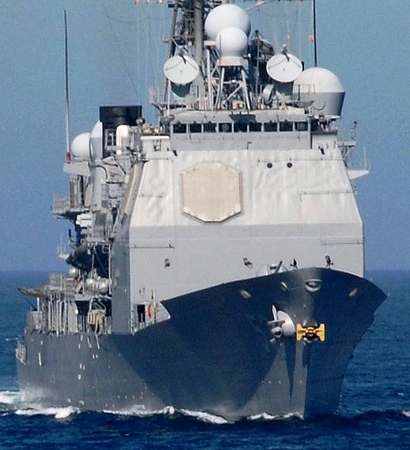
At left (Fig. 29, upper left) is a photo of the forward bow section of the USS Zumwalt, DDG 1000 ... (Cavas, and Defense News, 2013).[85] Most obvious in this photo is the structural omission of a flared, outward sloping, topside prow or hurricane bow and submergence inhibitor. As a tertiary concern, as the bow of the DDG 1000 tends to shove water up on to the vessels foredeck, am curious to know if such acute and inward sloping prow design will be more or less prone to accumulating ice. The current tumblehome hull having me suspect that the DDG 1000 will accumulate more ice than that typically experienced by a flared hull bow. The forward hull structure, having an angled though still upright surface for ice to bond and start accumulating, ice on a flared hull bow vessel having to be secured in an inverted and hanging orientation, thus raising the probability that the tumblehome hull may gain ice weight in a most undesirable and forward location of the hull adversely effecting ship handling, the vessel turning nose heavy. A location of the vessel, should ice start forming, not easily addressed if not nearly impossible while underway to mitigate using the typical mechanical means utilized by the US Navy today, myself having removed ice from a US Navy vessel once before while underway in the Sea of Japan with the standard supplied ice pick and hammer. (Fig. 30, upper right) Head on photo of the forward bow section of the lead ship USS Arleigh Burke, DDG 51 (US Navy, 2005).[86] Note the large flaring hurricane bow and not present on the DDG 1000. (Fig. 31, lower left) Head on bow shot photo of the underway Ticonderoga class cruiser, USS Mobile Bay (CG 53)(xxxx, xxxx) This vessel having the most flared hurricane bow of any US Navy combatant vessel. (Vid. 6, 696 KB wmv, lower right) is a video of a pitch and heave tank test using a model of a standard hull vessel with hurricane bow USS Zumwalt, DDG 1000, void of a hurricane bow, more prone to pitching into the water, as the forward portion of the ship hull, occupying less volume, displacing less water. Hence, producing ... (..., 2007). [32]
[87]
[88][89]
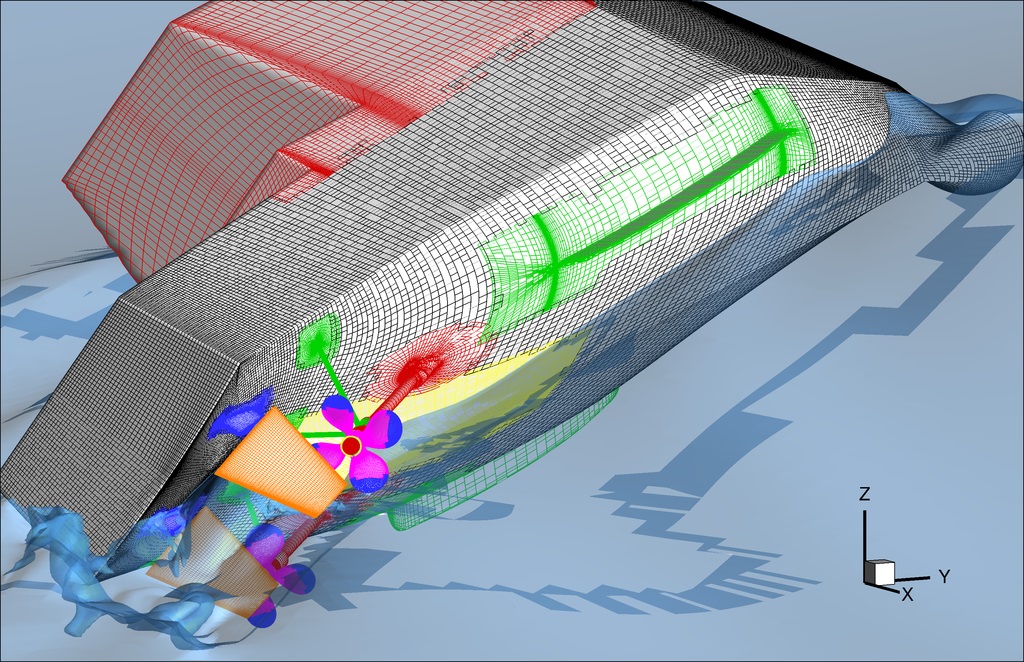
(Fig. 32, left) Computer wireframe simulation of the DDG 1000 tumblehome hull broaching to the port side while attempting to perform a hard to starboard maneuver (ONR, and CFDShip-IOWA, 2011).[90] From examining the lone nature of the vessel's wake can deduce that the this broaching event occurs in claim water conditions of sea state [0]. (Vid. 7, 667 KB, wmv, right) Video showing the bottom view perspective of the ONR tumblehome hull, USS Zumwalt DDG 1000 during broaching. The vessel near the end of the broaching event experiencing pure-loss of stability resulting in capsizing of the ship to the port (left) side (xxxx, 2007).[91] The simulated sea conditions used for the test, and easily determinable by scaling the starboard (right) bow wake relative to the destroyer's hull width, operating in near still seas, sea state [0], or ideal environment.
The tumblehome hull in the video, experiencing sea conditions from which the vessel should be least vulnerable or susceptible to broaching and or capsizing. The DDG 1000 design, per computer modeling of capsize risk (see Fig. 15) in real world circumstances, incline to be more vulnerable to such complete systems requirements failure of the vessel, compounded with the tragic potential of the loss of all hands. Furthermore, the tumblehome's susceptibility to broaching should be accentuated while in high sea conditions or while performing a hard to port or starboard maneuver at flank speed in rough choppy seas, windy conditions, while experiencing intervention maneuvers performed by another vessel(s), and perhaps in some rare circumstances, while traversing the wake of a fast moving larger vessel such as an aircraft carrier.
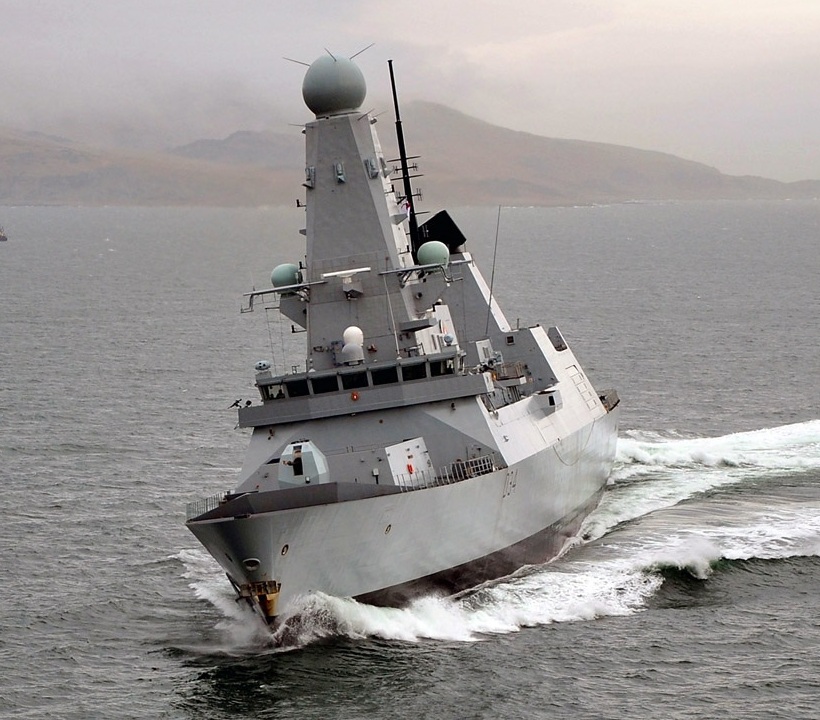
The DDG1000 perhaps constrained even in calm seas to performing limited high speed maneuvers having already demonstrated from computer models to being susceptible to heeling induced broaching. The US Navy yet to release any operational results of the Tumblehome Hull under such dynamics as high speed turns of an extended nature such as the high speed figure 8 marvelously performed (Fig. xx)[xx] by the Royal British Navy's, Type 45 Destroyer, HMS Dragon.[xx] The risk of heeling induced broaching increasing with sea state conditions as the maneuvering hull becomes exposed to quartering (oblique) waves.
[xx][xx]
(Fig. xx, left) Royal British Navy, Type 45 Destroyer, HMS Dragon, heeling to the starboard during a high speed turn (xxxx, xxxx; adapted, McGraw, 2016).[xx] (Fig. xx, right) Royal British Navy, Type 45 Destroyer, HMS Dragon, performing a series of superb high speed turning maneuvers resulting in a figure 8, after which returning to original course (xxxx, xxxx).[xx]
Hull comparison between the Arleigh Burke class DDG 51 Flight IIA, and Zumwalt class DDG 1000
[92], [93], [94], [95], [96], [97], [98]
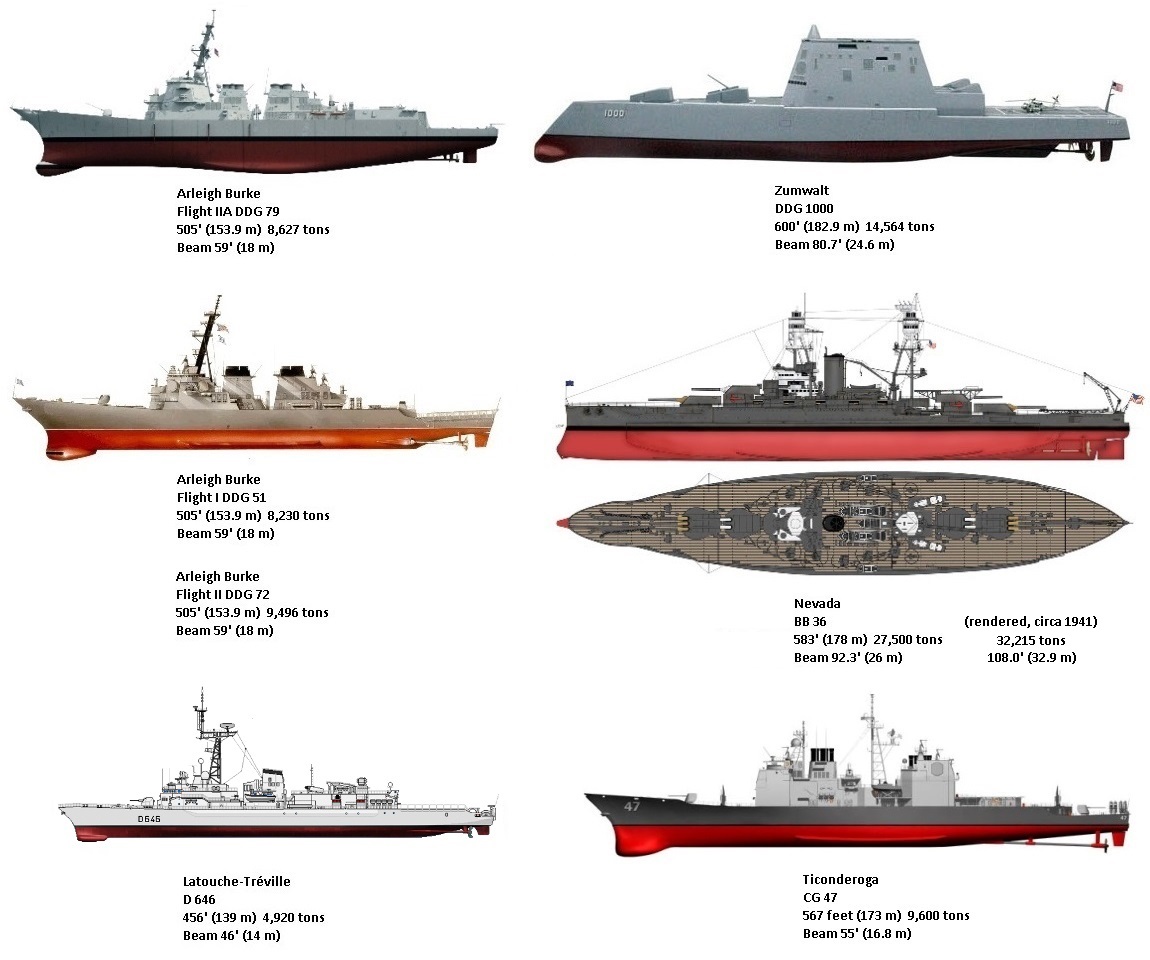
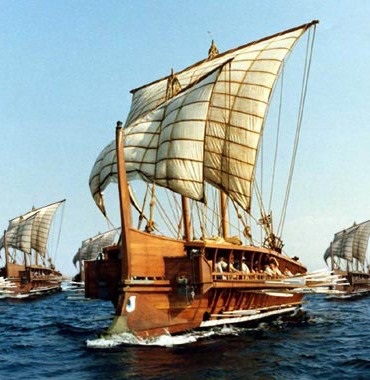
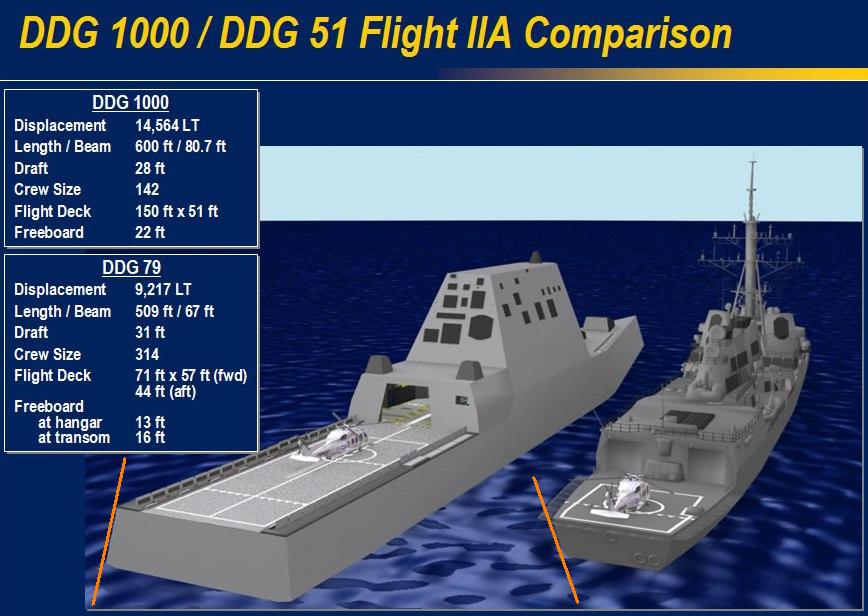
(Fig. 33, above) Scaled drawings comparing the USS Zumwalt DDG 1000 (top right)[99] with the Arleigh Burke DDG Flights I, II, IIA (US Navy 2005; adapted, McGraw, 2013)[100] and F-70 Latouche-Tréville D 646 (xxxx, xxxx; xxxx, xxxx; adapted, McGraw, 2013)(left column)[101], [102] along with the USS Nevada BB 36 (center right)(Raven, and Friedman, 1986; Walkowiak, xxxx; adapted Lipiecki, 2007; adapted, McGraw, 2013)[103] and USS Ticonderoga CG 47 (xxxx, xxxx; adapted, McGraw, 2013).[104] The USS Nevada meeting the classic definition of a tumblehome hull, with the width of the vessel at the gunwale lip (weather deck) being more narrow than the width of the vessel at the beam (waterline) presenting a convex curvature on the exterior topsides (xxxx, xxxx).[105] The hull's converging topside acute angles resulting in a naturally forming, rearward pointing, tapered bow on the USS Zumwalt, and similar to that seen on the USS Nevada. This bow morphology, and frequently understood as a visible characteristic of a tumblehome hull, is in fact, a non absolute defining element of the design, there being other vessels with inward sloping rearward tapered bows such as that seen on the Greek trireme galleys (Fig. 34, below left) used during the Peloponnesian War (406 - 404 BCE)(xxxx, xxxx)[106], fitted with a flam like, outward sloping topsides hull for the majority of the vessel's length (Fig. 35, below right).
[107][108]
[109][110] [111][112]
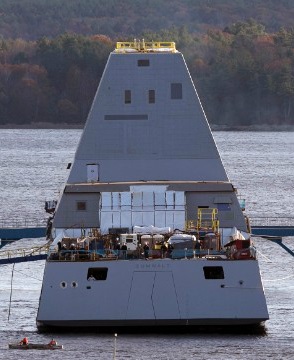
(Fig. 36, upper left) Stern view of the newly floated and slightly listing to port, USS Zumwalt DDG 1000 (Bukaty, and AP, 2013).[113] (Fig. 37, upper right) Stern view of Arleigh Burke class destroyer Flight I (51-71), USS Gonzalez DDG 66 (US Navy, 2005).[114] This stern view scaled to match the photo of the USS Zumwalt at left. The Arleigh Burke class vessel having a flared hull, placing the ship's girdle (vessel's widest width irrespective of waterline width or vessel beam) above the waterline near the top of the freeboard where as the girdle and beam location on the Zumwalt class vessel being at the same height being located near the base of the freeboard. Fig. 38, lower left) Aft perspective, and exterior hull comparisons diagram of the DDG 1000, Zumwalt class verse the DDG 51 Flight IIA, Arleigh Burke class (Indian Defense Forum, Nov 2011)[115] with wallsided upper hull (Ellis, 1997).[116] Note the very different freeboard angles (orange lines) at the stern of the two vessels, and extending along the hull water line to beyond the hanger bay of the Zumwalt (acute), and Arleigh Burke (obtuse) shaped hulls. The acute, inward sloping angle of the freeboard on the Zumwalt class vessel, perhaps leading to additional water to be dispersed upon the flight deck while performing hard turns and during rough sea conditions. The flaring nature of the freeboard on the Arleigh Burke class providing a self-righting property to the hull, helping to mitigate the onset of parametric oscillation of the hull. (Fig. 39, lower right) Photo of the 1,000 ton steel based (Huntington Ingalls, and Defense News, 2012),[117] balsa wood and synthetic compound composite deckhouse superstructure for the USS Zumwalt, DDG 1000 (xxxx, 2012)[118] The external dimensions of ....[119] The US Naval Sea Systems Command (NAVSEA) deciding in August 2013 to produce the third Zumwalt class deckhouse for DDG 1002, the USS Lyndon B. Johnson from all steel as appose to being a steel and composite blend. The need for integrating composite materials for weight reduction, per NAVSEA being alleviated with the removal of mass from other areas of the superstructure, thus permitting the use of all steel for this portion of the vessel (LaGrone, 2013).[120]
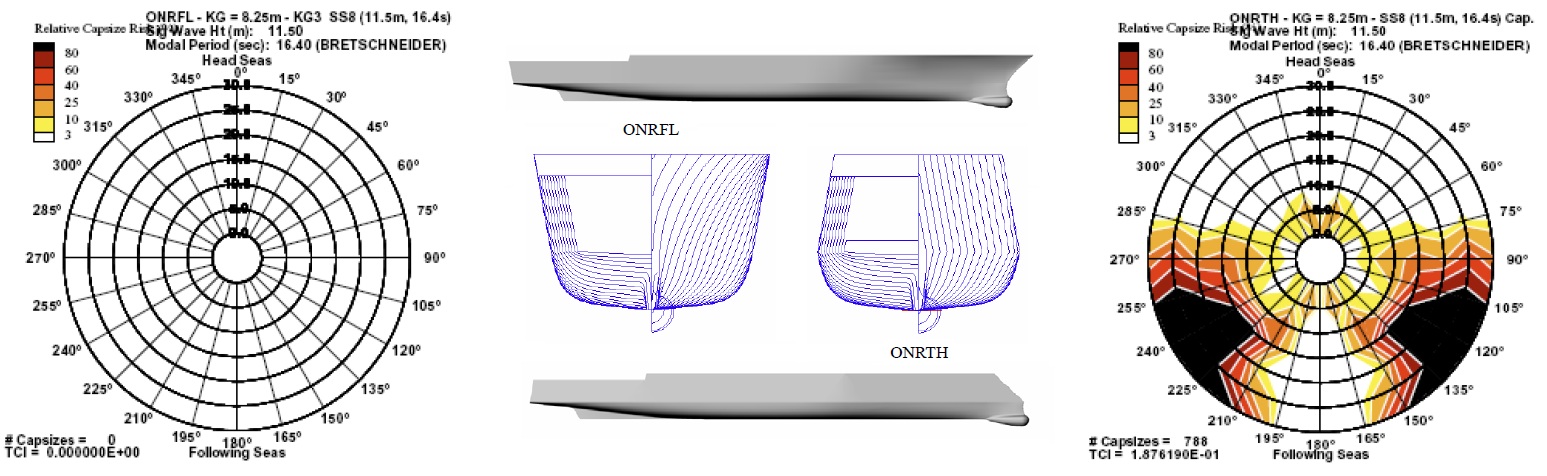
Hull comparison between ONRFL Topside Series and ONRTH Tumblehome Zumwalt Class DDG 1000
[121] [xxx] [122]
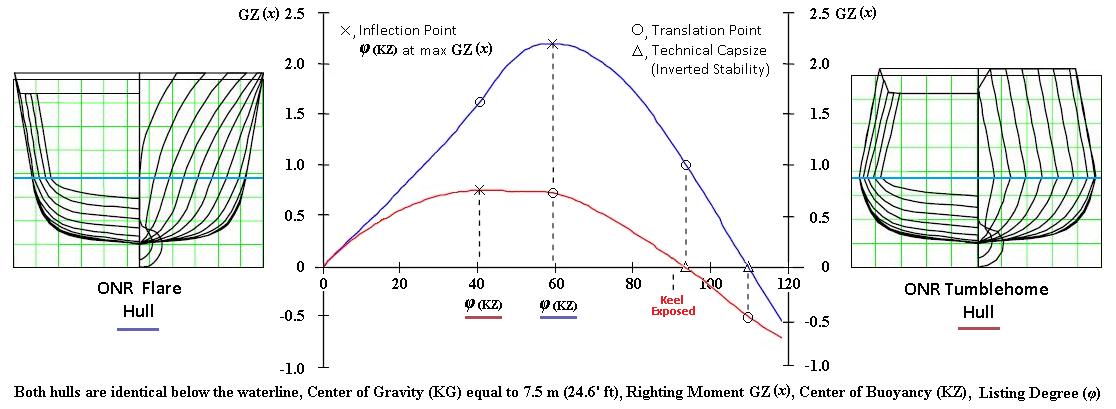
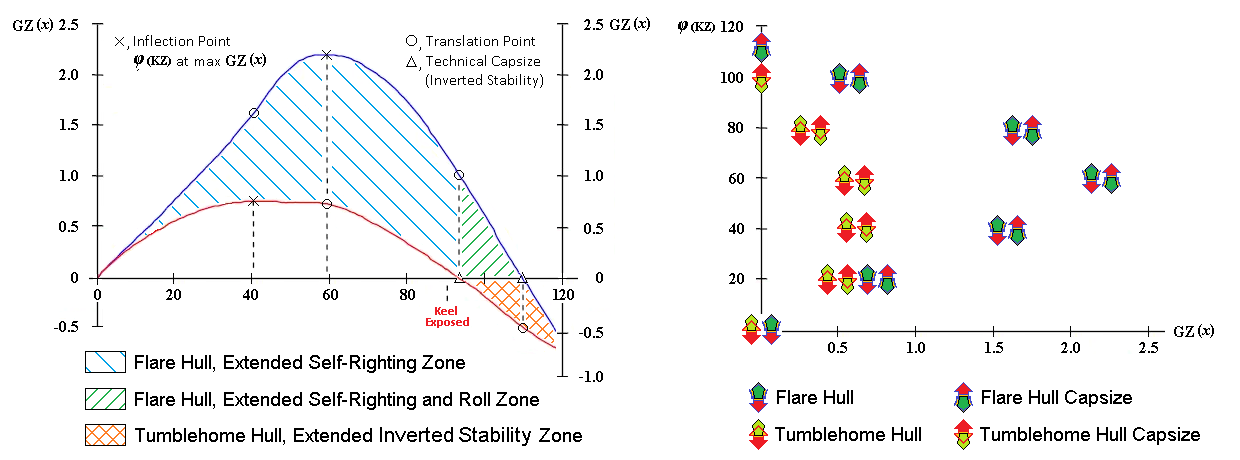
(Fig. 40, upper) Graph comparing the "restoring" or "righting moment" (GZx) of a topside series ONR flare hull (left) to that of an ONR tumblehome hull (right) relative to listing angle (φ) about the center of buoyancy (KZ), both hulls being identical below the waterline (light blue line), the center of gravity (KG) being equal to 7.5 m (24.6' ft)(Belenky and Bassler, 2010; adapted, McGraw, 2013).[123] The righting moment (GZx) displacement being greater for the flare hull (blue curve) having nearly 2.5x times more resorting moment at ~41o degrees than the tumblehome hull and over 3x times the restoring moment at the curve's maximum value of ~59o degrees. In addition, the ONR flare hull possesses greater angular restoring range prior to experiencing pure loss of stability and location (∆) where the function (GZx) crosses x axis, or "angle of vanishing stability" (AVS) with a value of ~109o degrees, besting the value of ~93o degrees for the tumblehome hull (red curve). The amplitude of the graphs reducing for both hull types, the peak value of each curve translating to the left and trailing off faster at right as sea state conditions increase. At the angular moment the tumblehome hull has reached technical capsize, (∆) having zero resorting moment (GZx) remaining, the flare hull for the same amount of listing, (φKZ) retaining more (GZx) than the tumblehome hull had at its max (GZx) value. Overall, the (GZx) vs. (φKZ) graph indicating that a tumblehome hull should succumb to pure loss of stability or technical capsize, prior to a flare hulled vessel of similar proportion. (Fig. xx, center) Graphs showing at left, the extedended self-righting (restoring) force (blue) and extended roll zone (green) for the ONR Flare Hull. The tumblehome hull having an extended inverted stability zone (orange)(Belenky and Bassler, 2010; adapted, McGraw, 2016). At right, the necessary (GZx) force required per roll angle (φKZ) to capsize the ONR Flare and Tumblehome hulls and compressed stablity zone relative to the ONR Flare Hull (McGraw, 2016; Belenky and Bassler, 2010). (Fig. 41, lower) Section views of ONRFL flare hull (left) and ONRTH Tumblehome hull (right) with respective polar plot representing capsize risk (Peters, Campbell, Belknap, and McCue, 2007).[124]
Basic Vessel Seamanship and Ship Handling
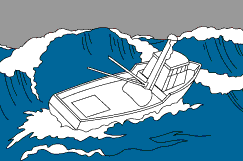
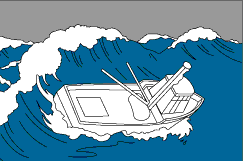
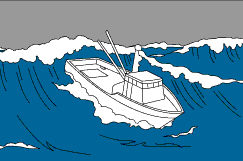
In addition to Head Seas, there are 3 critical wave to vessel orientations i) Beam Seas, ii) Quartering (oblique)[125] Seas, iii) Following (stern) Seas ... [126] ....
[127][128][129]
(Figs. 42-44) Wave to vessel orientation (Transport Canada, 2003)
The illustration at left (Fig. 42, left) represents beam seas.[130] The illustration at center (Fig. 43, center) represents quartering (oblique) seas.[131] The illustration at right (Fig. 44, right) represents following (stern) seas.[132]
Per common teaching, there are 3 primary means, other than structural failure of the hull, that a ship can invert or capsize. The first being a sudden and Pure-loss of Stability caused by a non repetitive motion of the hull, resulting in capsize. Such events typically occurring near the vicinity of a wave crest and region with negative reversion and roll restoration initiated by insufficient forward motion relative the surrounding water as the vessel attempts to transit the wave.
[133][134]
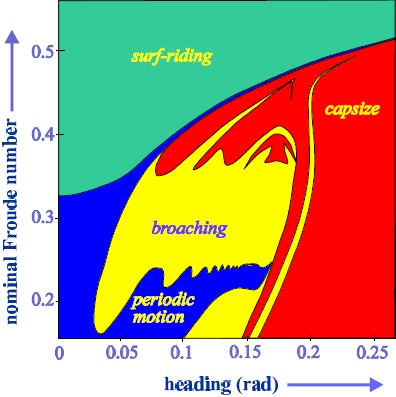
At left (Fig. 45, left) is a plot representing the transformation of ships forward motion from crest to trough ... .[135] The graph at right (Fig. 46, right) indicates some of the typical conditions in which a vessel may experience broaching, ... .[136].
The second means of capsizing being caused by Parametric Instability. This being the product of progressively increasing rolls of the vessel hull from port to starboard (left - right) as result of basic mechanical properties inherent to the vessel, such as momentum and inertia. This being a more common concern for vessels operating with a high center of gravity and low center of buoyancy, such as the USS Zumwalt, DDG 1000.
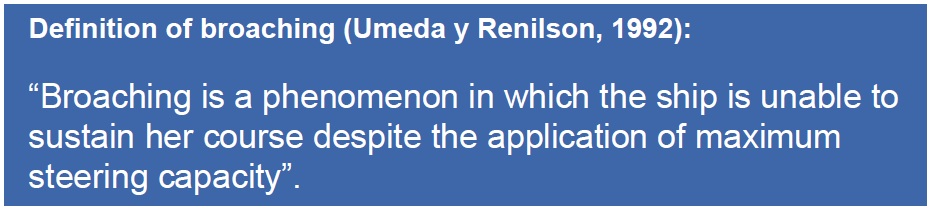
The last common means of vessel capsizing being the product of Broaching. In simple term, the lost of directional control from an otherwise controlled vessel followed by an even larger and unintended rotation about the azimuthal plane. The inherent mechanical loads upon the vessel, as it heels in a turn, leading to capsizing post the critical angle for the given conditions. This event occurring more frequently with the vessel's amidships situated near the wave trough, the vessel being less than one wave in length. A slightly quartering (oblique) sea, with waves moving inwards towards the stern of vessel with a shallow angel relative to the longitudinal axis of the vessel compounding the effect of capsizing.[137]
The act of broaching by a ship being very similar to an automobile sliding in a fishtailing manner as it make a high speed tight turn, reaching a point where the driver is no longer in controller as to which direction the automobile is heading, eventually flipping the vehicle over at some point about the arcing path, away from the central point of revolution. A slight wind from the rear of the vehicle, lowing the flipping thresh hold.
Attempting to match ship's velocity with wave frequency to help alleviate pitching of the hull, and handling option not typically available to an engaging warship ... .[138] Altering ship's velocity with wave timing to reduce parametric rolling of the hull... . [139]
[140][141]
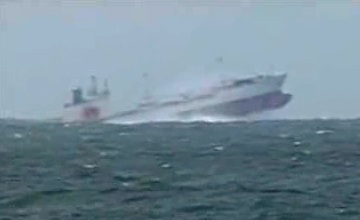
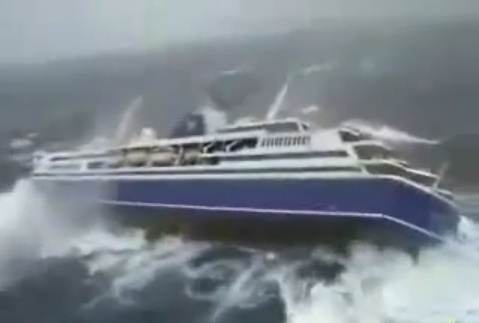
(Figs. 47-48) Vessel Motion in High Seas
The still video frame at left (Fig. 47, left) shows a freighter experiencing pitching in high seas... .[63]. The still video frame at right (Fig. 48, right) shows a cruise ship experiencing parametric rolls in high seas... .[142]
Preventing the vessel from broaching... .[148] The driving effects to broaching being two fold... .[149]....
Performance Predictions for DDG 1000 Tumblehome Hull
[150] [151]
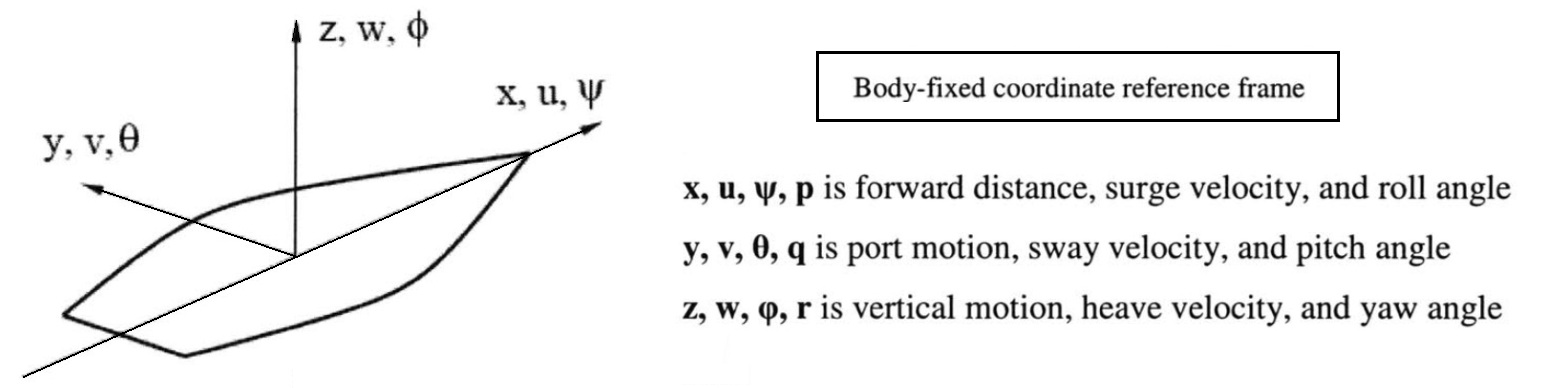
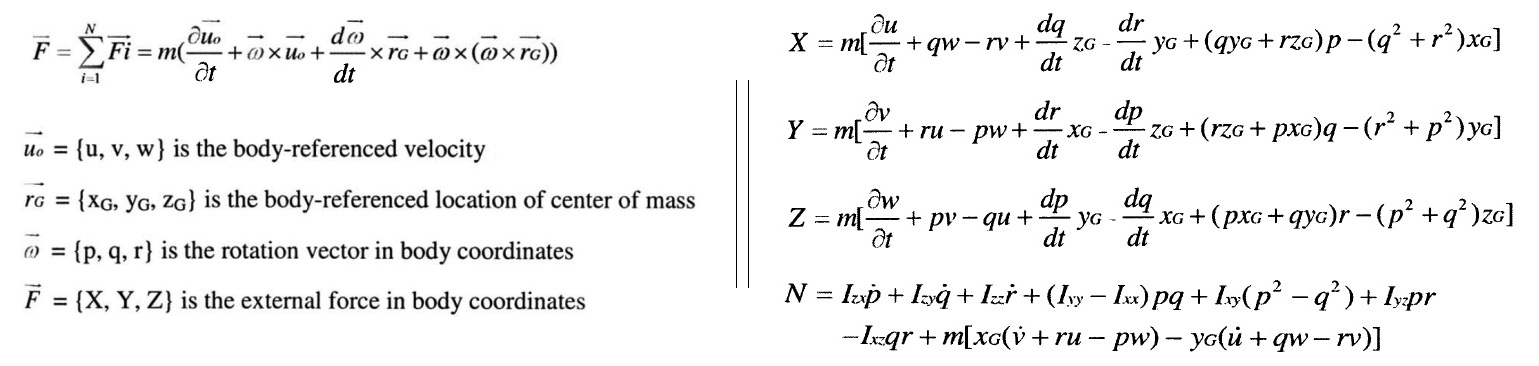
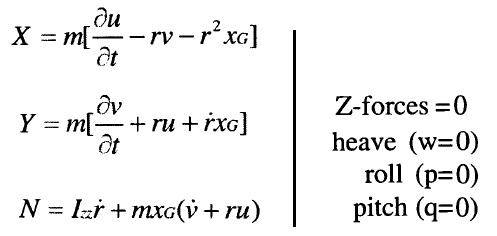
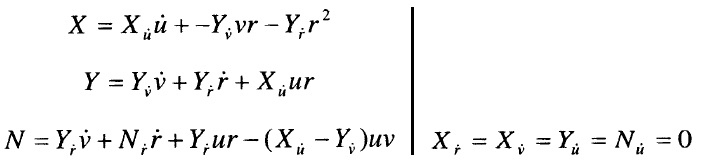
(Figs. 49, 50) Coordinate reference frame diagram and variables along with variables and simplified general equations representing the sum of the forces and linear moment of inertia acting on a kayak hull representing the DDG 1000 Tumblehome Hull.[152].
Upper is ... .[153].
Lower is ... .[154].
[155]
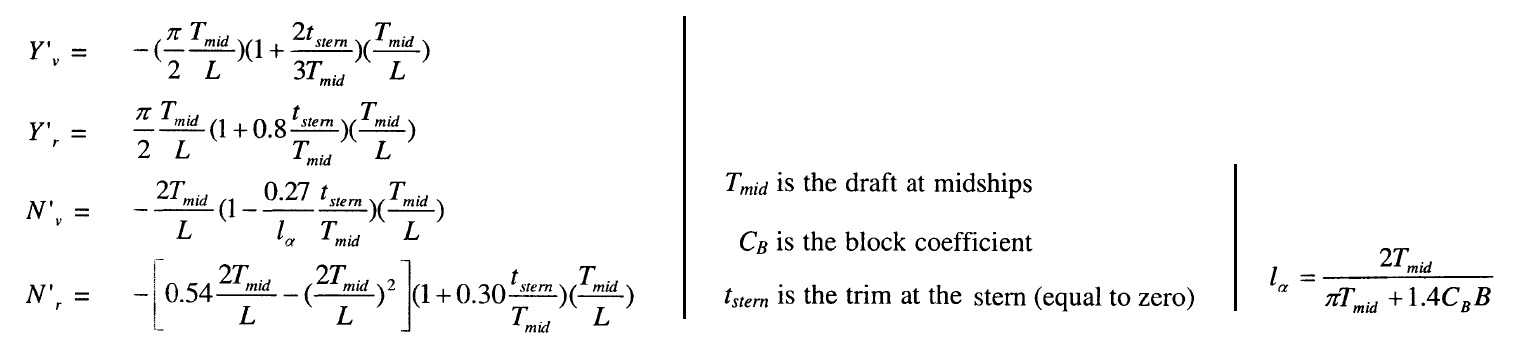
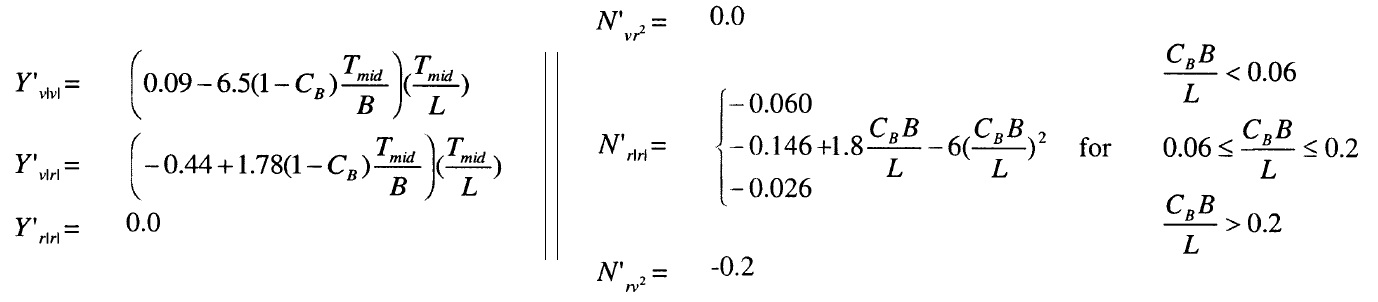
Complete non linear (horizontal) equations of motions (Fig. 51) for kayak hull representing the DDG 1000 hull ...
[156] [157]
(Fig. 52, upper) Force equations for fluid inertia ... .[158].
(Fig. 53, lower) The following set of equations ... .[159].
At right is ... .[160].
[161] [162]
(Figs. 54, 55) Equations for non-linear axial (upper) and crossflow (lower) drag coefficients.[163]
At top is ... .[164].
At bottom is ... .[165].
Physical, Ship to Ship, Movement Intervention
Ships movement, in particular, the concept of Free or Innocent Passage[166] ....
[167][168]
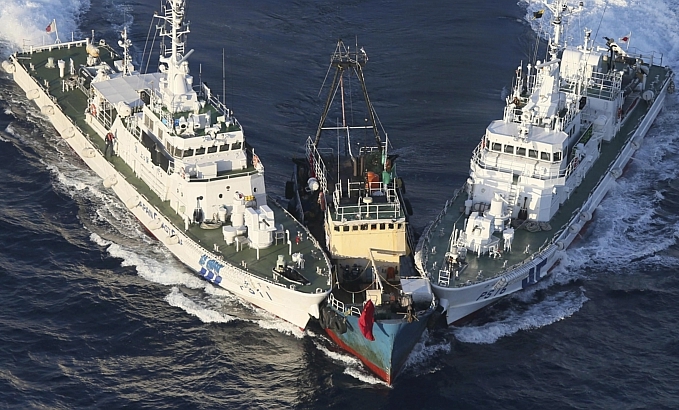
(Figs. 56, 57) Photos of ship to ship contact in an effort to prevent ships movement. The naval act of ship to ship contact being fairly common (Rolph, 1992: Pedrozo, 2012).[169], [170]
At left (Fig. 56, left) is a photo of the US Navy Ticonderoga class cruiser USS Yorktown (CG 48) exercising the international maritime right of Innocent Passage in Black Sea near the Crimean Peninsula, being struck along the port side (left) by the movement inhibiting Russian frigate SRN Bezzavetny (FFG 811), 12 February 1988 (Hurst, 1988).[171], [172]
At right (Fig. 57, right) is a photo (Morita, 2012) taken on 15 August 2012 of two Japanese Coast Guard vessels (Taylor, 2012)[173] of the Raizan Patrol Ship class, or the former Bizan Class (renamed Banna)(Wertheim, 2007),[174] JCG Muzuki PS 11 and JCG Nobaru PS 16[175] colliding in the East China Sea near Uotsuri Island in the Senkaku Islands Chain (Japan)(Diaoyu, PRC)(Tiaoyutai, ROC) (Taylor, 2012)[176] in an attempt to inhibit movement by a fishing vessel from Hong Kong (Brown, 2012).[177] The outward sloping prow of both of the Japanese vessels permitting for the coordinated apprehending via compression capturing of the vessel of interest. An inward sloping prow, such as that integrated to the USS Zumwalt, beyond simply blocking the path of a vessel, making coordinated capture maneuvers with another vessel extremely challenging if at all possible to perform.
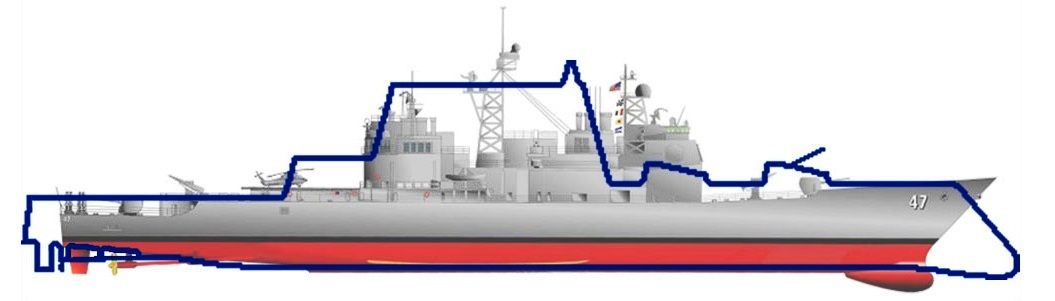
The inverted shape of the Tumblehome hull perhaps strongly limiting the opportunity for ships movement intended to inhibit the forward progress or the forced vectoring of a secondary vessel. Upon contact, the far forward portion of the Tumblehome hull, from shape, being submerged upon impact, hence slowed in forward motion.(Fig. 58)
[178]
(Fig. 58) Ship profile (elevation) diagram comparing the USS Ticonderoga CG 47 class relative to the USS Zumwalt DDG 1000 class.[179]
The leading portion of the sonar dome, as the furthest extending portion of the vessel's hull, being highly vulnerable to damage of a non at sea serviceable nature, severely disabling the vessel's capacity to perform anti-submarine warfare mission post collision. The Tumblehome vessel, more than likely suffered acoustic blinding with the loss of the principle sonar transducer.
Such as the incident occurring on 12 February 1988, the US Navy exercising Right of Free (Innocent) Passage, the USS Yorktown (CG 48) transiting in the Black Sea near Sebastopol, being hit by the Russian frigate SRN Bezzavetny (FFG 811). The SRN Bezzavetny attempting to inhibit, with hull to hull contact, ships movement by the USS Yorktown. Below are video 1 and video 2 of the incident recorded from the USS Yorktown, taken by .... (US Navy).[180]
[181][182]
(Vid. 11, 14.5 MB wmv, left) Recorded from the port side of the bridge on the USS Yorktown CG 48, Part I of the ship to ship confrontation between the US and Russian Navies (US Navy, xxxx)[183] that occurred .... The US Navy exercising in international territory the internationally recognized maritime right of "Free (Innocent) Passage" by the USS Yorktown (CG 48) in the Black Sea near Sebastopol, colliding with the movement inhibiting Russian frigate SRN Bezzavetny (FFG 811)(xxxx, xxxx).[184] (Vid. 12, 13.4 MB wmv, right) Part II of the USS Yorktown (CG 48), Black Sea free passage incident (US Navy, xxxx).[185] The static noise seen on the videos being produced by the various radiating RF systems onboard the two ships, the crewman on the USS Yorktown heard mentioning the AN/SPS 49 air search radar as possibly corrupting the quality of the recording.
Ancillary Discussion - USS Zumwalt, DDG 1000 Naval Gun System
The Process of Deploying of the deck gun barrel, on the USS Zumwalt, unlike traditional ship borne gun systems for the past 100 years, ... [113] ....
[186][187]
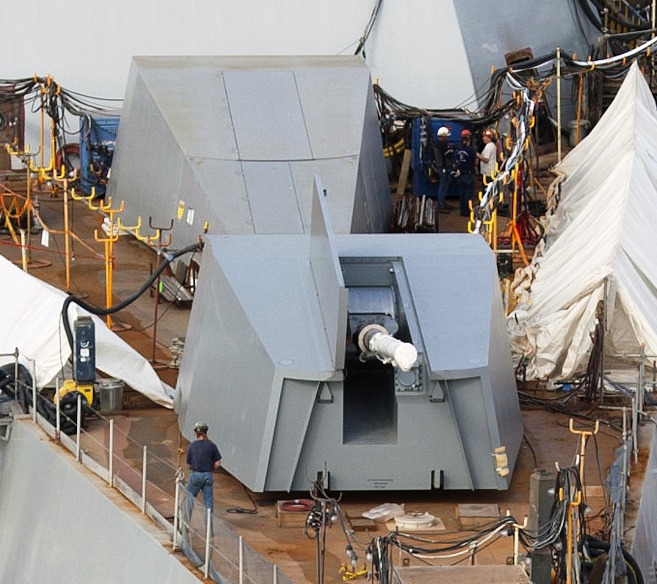
(Fig. 59, left) Photo of the Arleigh Burke class US Winston Churchill (DDG 81) exercising her 5 inch MK 45 Mod 4 Gun, controlled by the MK 160 Gun Computer System (GCS), (US Navy, 2004).[188] (Fig. 60, right) Photo (Cavas, 2013) of the two 155 mm AGS (6" inch) deck guns on the USS Zumwalt.[189] The aft gun closest the deckhouse superstructure having its full gun barrel forward shroud on the gun mount housing installed. Note how the gun barrel, and visible of the forward gun mount, is not coincident with the longitudinal centerline of the gun mount housing, fashioned in an asymmetric manner, and rather unique for the US Navy.[190]
... (xxxx, xxxx) [xxx] ....
In closing and independent of this discussion along with shared concerns pertaining to possible sea worthiness issues surrounding the use of a tumblehome hull for the US Navy, DDG 1000 USS Zumwalt, having been launched with the vessel being fitted for service, wish the ship and her crew all the best, safely returning after each deployment.
[1, 2] Video still frames of USS Zumwalt DDG 1000 Tumblehome Hull model test, Defense News, Chris Cavas, Fall 2006.
[2a] Predication of Performance and Maneuvering Dynamics for Marine Vehicles Applied to DDG-1000, Louis-Philippe M. Menard et. al., (Massachusetts Institute of Technology), Master of Science in Naval Architecture and Marine Engineering and Master of Science in Mechanical Engineering, 04 June 2010, Massachusetts Institute of Technology, Cambridge Massachusetts, retrieved 04 Nov 2012, (6.55 MB pdf); http://dspace.mit.edu/bitstream/handle/1721.1/61913/707091168.pdf?sequence=1.
[4] Dynamic Stability of Flared and Tumblehome Hull Forms in Waves, 04 Sep 2007, Christopher Bassler, et. al., Andrew Peters, Bradley Campbell, William Belknap, and Leigh McCue, (Seakeeping Division, Naval Surface Warfare Center, Carderock Division; QinetiQ; Seakeeping Division, Naval Surface Warfare Center, Carderock Division; Seakeeping Division, Naval Surface Warfare Center, Carderock Division, Aerospace and Ocean Engineering, Virginia Tech), pg. xx, retrieved 02 Jun 2012, (551 KB pdf); http://http://www.dept.aoe.vt.edu/~mccue/papers_archive/bassler_etal_stab07.pdf.
[5] Non-Linear Rolling of Ships in Large Sea Waves, Master's Thesis, 11 May 2007, Scott M. Vanden Berg, et. al., Jerome H. Milgram ad., Joel P. Harbour rd., (Massachusetts Institute of Technology, Boston MA), pgs. 13, 16, 26, 47, 48, retrieved 27 May 2012, (5.67 MB pdf); http://dspace.mit.edu/bitstream/handle/1721.1/40367/190861393.pdf.
[6 - 9] Video still frames of USS Zumwalt DDG 1000 Tumblehome Hull model test, Defense News, Chris Cavas, Fall 2006.
[10] An Investigation Into The Damaged Stability Of A Tumblehome Hull Warship Design, Master’s Thesis, Brian T. Ellis, September 1997, et. al., Charles N. Calvano, ad., (Naval Postgraduate School, Monterey CA), pgs. 16 - 18, Unclassified, NSN 7540-01-280-5500, retrieved 27 May 2012, (3.30 MB pdf); http://www.dtic.mil/cgi-bin/GetTRDoc?AD=ADA338783.
[11 - 12] Video still frames of USS Zumwalt DDG 1000 Tumblehome Hull model test, Defense News, Chris Cavas, Fall 2006.
[14] Illustration, BIW shipbuilders moved the 1,850-ton Ultra Unit comprising the stern section of Zumwalt (DDG 1000) on to the Land Level Transfer Facility, flateric et., Zumwalt (DD-21/DD(X)/DDG-1000), Balancer.Ru, 2012, retrieved 10 Nov 2012; http://forums.airbase.ru/2011/06/t82261,7--zumwalt-dd-21-dd-x-ddg-1000.html.
[eg] Definition of broaching, Vessel Instabilities, Marcelo A. Santos Neves et. al. (LabOceano – COPPE/UFRJ), Engenharia Naval e Oceanica, Congrega os cursos de pós-graduação em engenharia, Universidade Federal do Rio de Janeiro, 07 Feb 2010, retrieved 11 Nov 2012; www.pasi.aoe.vt.edu/presentations/neves.pdf.
[19] An Investigation Into The Damaged Stability Of A Tumblehome Hull Warship Design, Master’s Thesis, Brian T. Ellis, September 1997, et. al., Charles N. Calvano, ad., (Naval Postgraduate School, Monterey CA), pg. 18, Unclassified, NSN 7540-01-280-5500, retrieved 27 May 2012, (3.30 MB pdf); http://www.dtic.mil/cgi-bin/GetTRDoc?AD=ADA338783.
[22] Video of USS Zumwalt DDG 1000 Tumblehome Hull model test, Defense News, Chris Cavas, Fall 2006.
[ra-rb] Dynamic Stability of Flared and Tumblehome Hull Forms in Waves, 04 Sep 2007, Christopher Bassler, et. al., Andrew Peters, Bradley Campbell, William Belknap, and Leigh McCue, (Seakeeping Division, Naval Surface Warfare Center, Carderock Division; QinetiQ; Seakeeping Division, Naval Surface Warfare Center, Carderock Division; Seakeeping Division, Naval Surface Warfare Center, Carderock Division, Aerospace and Ocean Engineering, Virginia Tech), pgs. 2, 11, 12, retrieved 02 Jun 2012, (551 KB pdf); http://http://www.dept.aoe.vt.edu/~mccue/papers_archive/bassler_etal_stab07.pdf.
[aa1] Vessel Instabilities, Marcelo A. Santos Neves et. al. (LabOceano – COPPE/UFRJ), Engenharia Naval e Oceanica, Congrega os cursos de pós-graduação em engenharia, Universidade Federal do Rio de Janeiro, 07 Feb 2010, retrieved 11 Nov 2012; www.pasi.aoe.vt.edu/presentations/neves.pdf.
[23] Predication of Performance and Maneuvering Dynamics for Marine Vehicles Applied to DDG-1000, Louis-Philippe M. Menard et. al., (Massachusetts Institute of Technology), Master of Science in Naval Architecture and Marine Engineering and Master of Science in Mechanical Engineering, 04 June 2010, Massachusetts Institute of Technology, Cambridge Massachusetts, retrieved 04 Nov 2012, (6.55 MB pdf); http://dspace.mit.edu/bitstream/handle/1721.1/61913/707091168.pdf?sequence=1.
[23a] Photo, Deckhouse for the USS Zumwalt, DDG 1000 (Huntington Ingalls Industries, and Defense News, 2012), >Huge DDG 1000 Deckhouse Ready for Shipment, Christopher Cavas, et. al., Intercepts, The official blog of Defense News, 09 Oct 2012, Defense News, retrieved 12 Nov 2012; http://blogs.defensenews.com/intercepts/files/2012/10/DDG1000-1210-deckhouse-021.jpg.
[26a] Nautical Knowledge for Pacific Island Mariners, Restricted Class 6 - Master/Engineer, SPC O21B, Learner’s Guide, Secretariat of the Pacific Community, Government of Taiwan/ROC, pg. 39, retrieved 11 Nov 2012; www.spc.int/DigitalLibrary/Doc/FAME/Manuals/nautical_lg.pdf.
[35] An Investigation Into The Damaged Stability Of A Tumblehome Hull Warship Design, Master’s Thesis, Brian T. Ellis, September 1997, et. al., Charles N. Calvano, ad., (Naval Postgraduate School, Monterey CA), pgs. 16 - 18, Unclassified, NSN 7540-01-280-5500, retrieved 27 May 2012, (3.30 MB pdf); http://www.dtic.mil/cgi-bin/GetTRDoc?AD=ADA338783.
[36] Freedom of Navigation and the Black Sea Bumping Incident: How Innocent Must Innocent Passage Be?, Lieutenant Commander John W. Rolph et. al., (Judge Advocate General's Corps, United States Navy), Military Law Review, Winter 1992, Volume 135, pgs. 137-165, Charlottesville, Virginia, Dep`t of Army Pamphlet 27-100-135, retrieved 02 Nov 2012; http://iilj.org/courses/documents/W.E.Butler.InnocentPassageandthe1982Convention.pdf.
[39] The U.S.-China Incidents at Sea Agreement: A Recipe for Disaster, Pete Pedrozo et. al., (U.S. Naval War College, ret.), Journal of National Security Law & Policy, Vol. 6, pgs. 207-226, 03 July 2012, retrieved 02 Nov 2012; http://jnslp.com/wp-content/uploads/2012/08/07_Pedrozo-Master.pdf.
[40] The U.S.-China Incidents at Sea Agreement: A Recipe for Disaster, Pete Pedrozo et. al., (U.S. Naval War College, ret.), Journal of National Security Law & Policy, Vol. 6, pgs. 207-226, 03 July 2012, retrieved 02 Nov 2012; http://jnslp.com/wp-content/uploads/2012/08/07_Pedrozo-Master.pdf.
[46] Photo, US Navy, Right of Free (Innocent) Passage, cruiser USS Yorktown (CG 48), Black Sea near Sebastopol, and Russian frigate SRN Bezzavetny (FFG 811), Defense Image VIRIN: DN-SN-92-00306, Robert Hurst et. al., (USS Yorktown, CG 48), NavSource Online: Cruiser Photo Archive USS YORKTOWN (DDG/CG 48), updated 07 Oct 2012, Paul R. Yarnall, and David Black ed., NavSource Naval History Photographic History of the U.S. Navy, retrieved 08 Nov 2012; http://www.navsource.org/archives/04/1148/04014822.jpg.
[47] Photo, Japanese Coast Guard patrol boats after Chinese activists near Uotsuri Island, 15 August 2012, Masataka Morita et. al., (Yomiuri Shimbun / AP), Anti-Japan Protests in China, Alan Taylor et. al. (The Atlantic), In Focus with Alan Taylor, 17 Sep 2012, The Atlantic, The Atlantic Monthly Group, retrieved 12 Nov 2012; http://cdn.theatlantic.com/static/infocus/jpcn091712/s_i19_65090714.jpg.
[48] Freedom of Navigation and the Black Sea Bumping Incident: How Innocent Must Innocent Passage Be?, Lieutenant Commander John W. Rolph et. al., (Judge Advocate General's Corps, United States Navy), Military Law Review, Winter 1992, Volume 135, pgs. 137-165, Charlottesville, Virginia, Dep`t of Army Pamphlet 27-100-135, retrieved 02 Nov 2012; http://iilj.org/courses/documents/W.E.Butler.InnocentPassageandthe1982Convention.pdf.
[48a] The U.S.-China Incidents at Sea Agreement: A Recipe for Disaster, Pete Pedrozo et. al., (U.S. Naval War College, ret.), Journal of National Security Law & Policy, Vol. 6, pgs. 207-226, 03 July 2012, retrieved 02 Nov 2012 (157 KB pdf); http://jnslp.com/wp-content/uploads/2012/08/07_Pedrozo-Master.pdf.
[49] NavSource Online: Cruiser Photo Archive USS YORKTOWN (DDG/CG 48), updated 07 Oct 2012, Paul R. Yarnall, and David Black ed., NavSource Naval History Photographic History of the U.S. Navy, retrieved 08 Nov 2012; http://www.navsource.org/archives/04/1148/040148.htm.
[50a] Naval Institute Guide to Combat Fleets of the World: Their Ships, Aircraft, and Systems (Naval Institute Guide to Combat Fleets of the World), 15th Edition, March 2007, Eric Wertheim et. al., United States Naval Institute Press, pg. 409, ISBN 978-1591149552
 [3]
[4]
[3]
[4]
 [x]
[x]
 [7]
[7]
 [8]
[8]
 [17]
[17]
 [18]
[18]
 [22]
[22]
 [23]
[23]
 [24]
[24]
 [25]
[25]
 [30]
[30]
.jpg) [31]
[31]
 [35]
[35]
 [36]
[36]
 [41] [42]
 [50]
[50]
 [51]
[51]
 [54]
[54]
 [55]
[55] 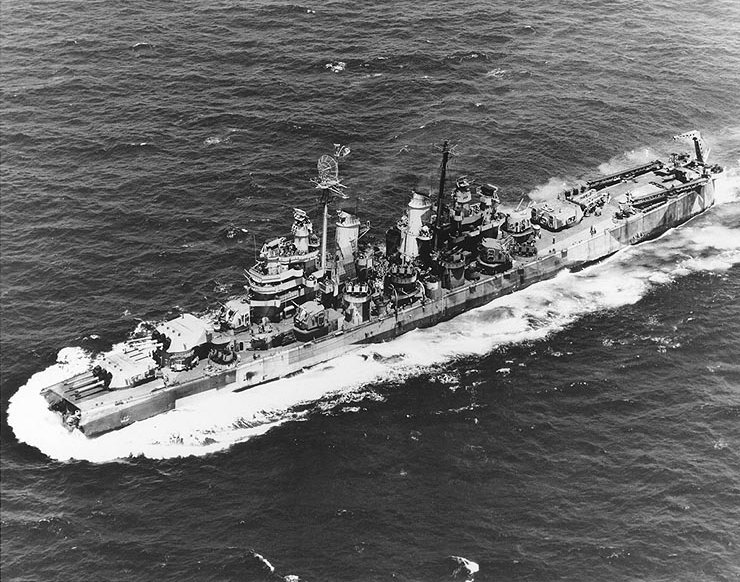 [xx]
[xx]
 [58]
[58]
 [59]
[59]
 [61]
[61]
 [71]
[71]
 [72]
[72]
 [81]
[81]
 [82]
[82]
 [83]
[84]
[83]
[84]
 [87]
[87]
 [88]
[89]
[88]
[89]
 [xx]
[xx] 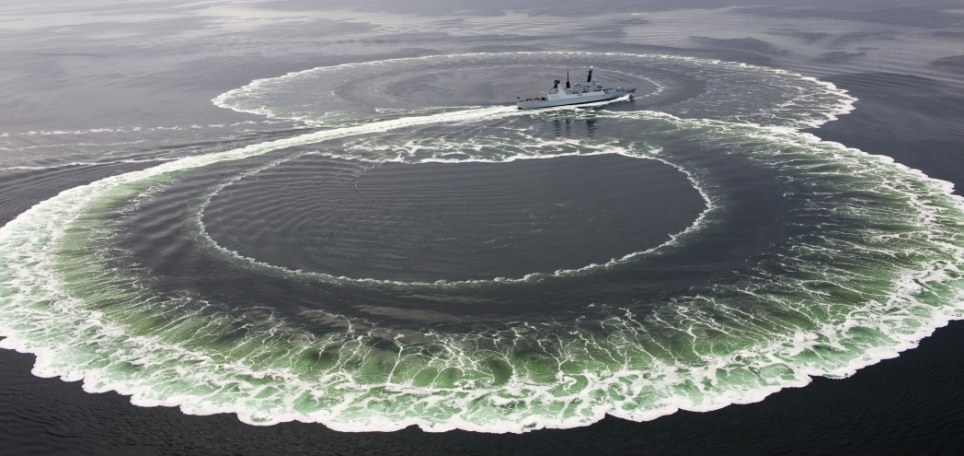 [xx]
[xx]
 [107]
[107] 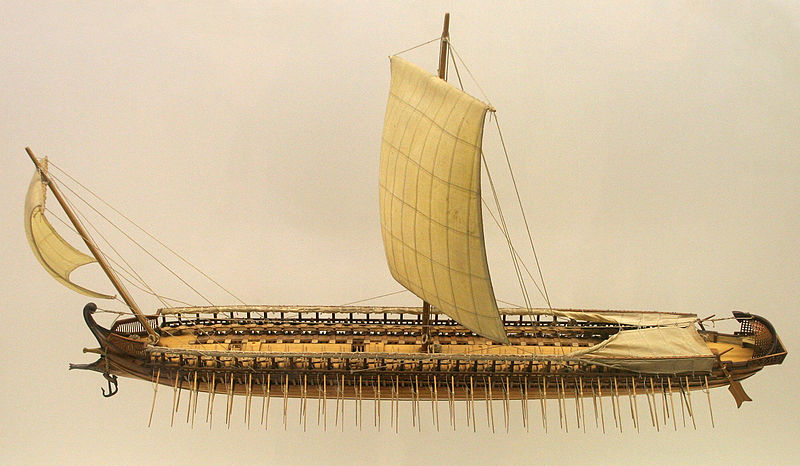 [108]
[108]
 [109]
[109] 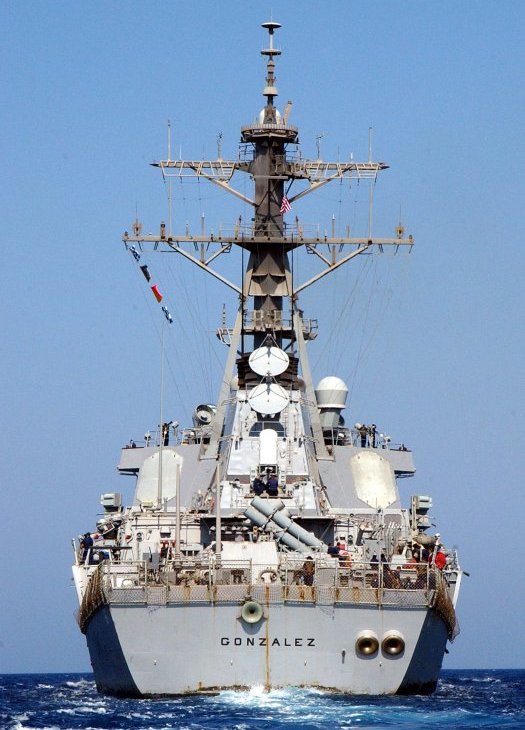 [110]
[110]
 [111]
[111] 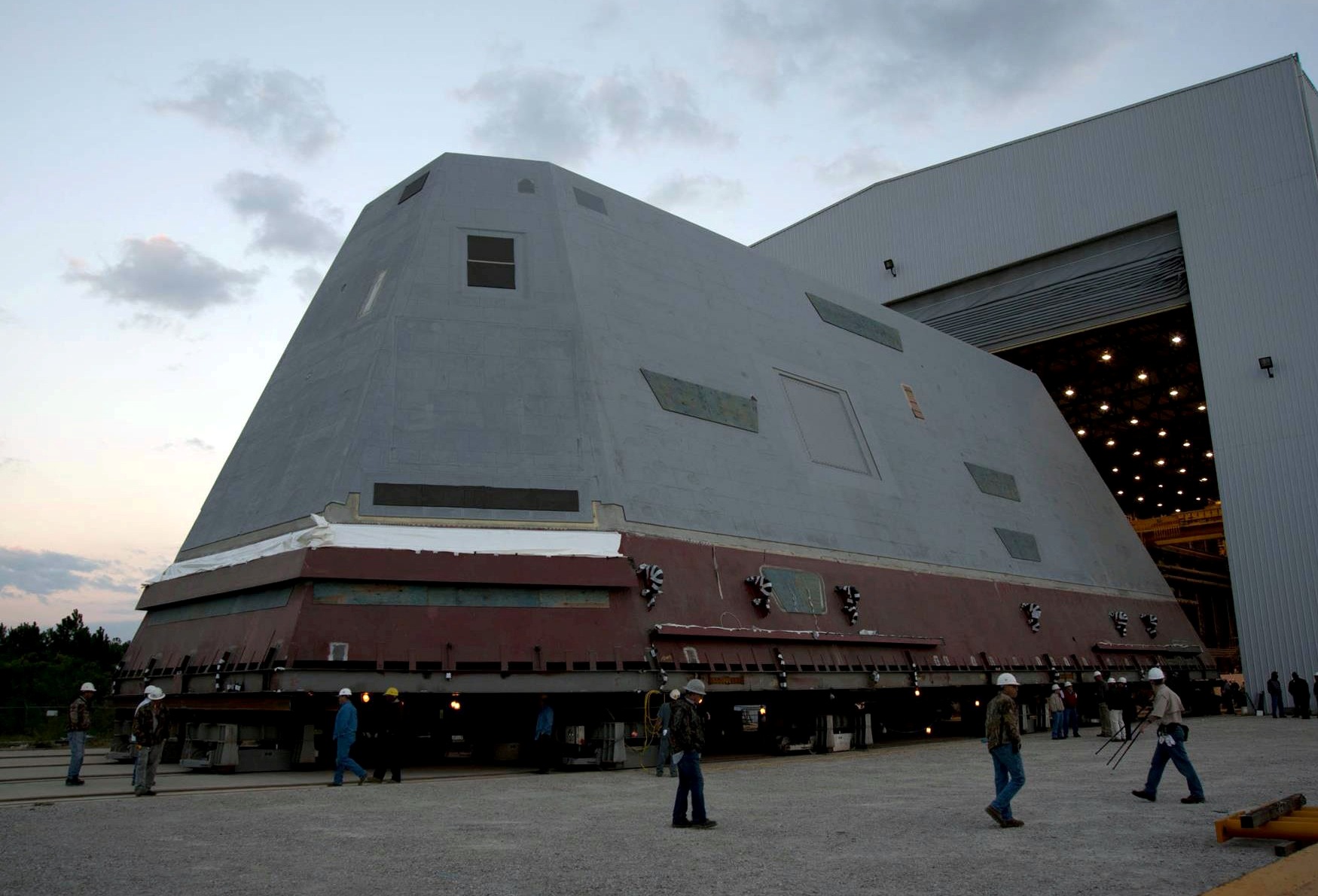 [112]
[112]
 [121]
[121]
 [xxx]
[xxx]
 [122]
[122]
 [127]
[127]
 [128]
[128]
 [129]
[129]
 [133]
[133]
 [134]
[134]
 [140]
[140]
 [141]
[141]
 [150]
[150]
 [151]
[151]
 [155]
[155]
 [156]
[156]
 [157]
[157]
 [161]
[161]
 [162]
[162]
-and-Bezzavetny_(FFG-811).jpg) [167]
[167]
 [168]
[168]
 [178]
[178]
 [75]
[75]
_5_inch_MK_45_Mod_4_Gun-c.jpg) [186]
[186]
 [187]
[187]


